
A crochet giraffe looks tricky because of that long neck, but in this pattern the neck is simply the body narrowing to 12 stitches and carrying on as a tube. You get a sitting giraffe about 8 inches tall, with brown hooves, a tan muzzle, two little ossicones (the horn knobs) and patches of brown stitched on last.
Under the pattern you will find advice on keeping the neck upright, a chart matching yarn to hook, and six more giraffe ideas, from a baby rattle to a tall shelf giraffe in cotton.
At a glance
Skill level
Advanced beginnerYarn
Worsted in mustard, brown and tanHook
3.5 mm (E-4)Finished size
About 8 inches tallTime
6 to 8 hoursStitches used
MR, sc, inc, dec, BLO, sl st
6 crochet giraffe designs to make
Every design lists the skill level, yarn and hook, with a note from the maker.
 LevelEasyYarnWorsted acrylicHook3.5 mm (E-4)
Sitting mustard giraffe
This sitting giraffe is the written one. The neck grows out of the body, so there is no weak seam at the base where most giraffes flop.
Maker note: Stuff the neck every 3 rounds with a chopstick. Waiting until the end leaves the middle soft.
 LevelEasyYarnWorsted cottonHook3.5 mm (E-4)
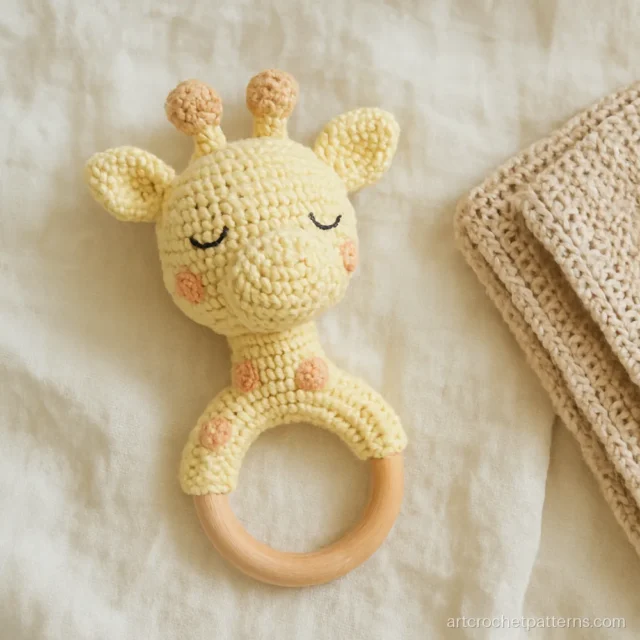
Pastel giraffe rattle
Just the head and neck on a ring, worked in pale cotton, with a rattle insert sealed inside the head. Eyes are stitched so it suits a baby.
Maker note: Wrap the rattle insert in a little fiberfill before closing the head, and sew the neck to the ring with tight stitches.
 LevelAdvancedYarnWorsted woolHook3.75 mm (F-5)
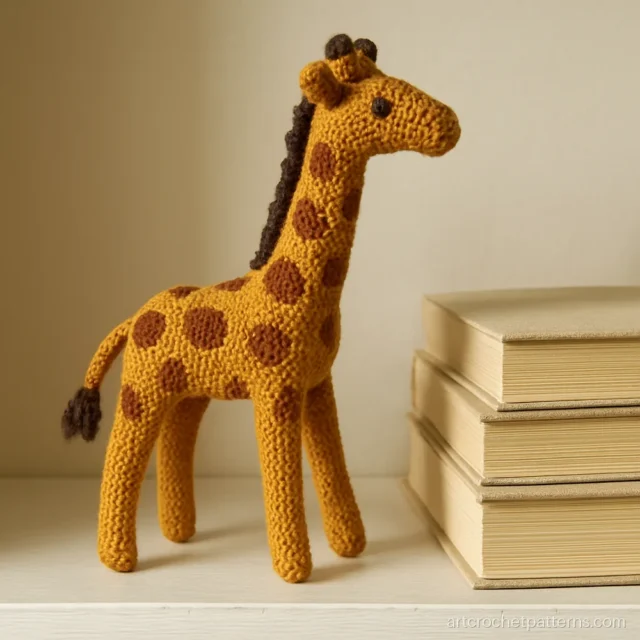
Tall standing giraffe in wool
Four long legs with wire inside let this one stand at 12 inches. It is a shelf piece for adults and older kids, not a toy for little ones.
Maker note: Make each leg 18 rounds of 9 sc and slip a bent pipe of wire up through the legs and body before stuffing.
 LevelBeginnerYarnDK acrylicHook2.75 mm (C-2)
Mini giraffe keyring
The head and neck only, in DK yarn, about 3 inches long. A fast gift for a teacher or a zoo lover.
Maker note: Embroider the spots with brown yarn instead of sewing patches. At this size patches look bulky.
 LevelEasyYarnBulky chenilleHook5 mm (H-8)
Giraffe lovey blanket
A giraffe head and neck sewn to the center of a 12 inch square of chenille. Little hands grab the neck like a handle.
Maker note: Keep the head stuffing light so the lovey stays floppy, and stitch the eyes rather than using plastic.
 LevelEasyYarnSport acrylicHook3 mm
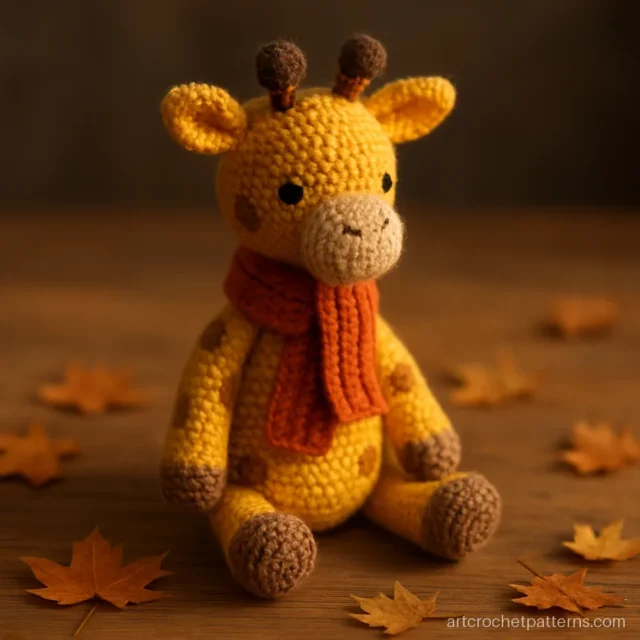
Autumn giraffe with a knit look scarf
A smaller sport weight giraffe wearing a scarf of slip stitch ribbing in rust. The scarf hides the neck to head seam neatly.
Maker note: Work the scarf in BLO slip stitches over 5 chains for 50 rows. It stretches and looks knitted.
Free giraffe crochet pattern: sitting giraffe
The pieces are a head, a muzzle, a body that turns into the neck, four legs, two ears, two ossicones, a tail and the spots. Work in a spiral and keep track of rounds with a marker.
Materials: worsted acrylic in mustard (about 110 yards), brown (30 yards) and tan (10 yards); 3.5 mm hook; two 9 mm safety eyes or black yarn; fiberfill; a chopstick for stuffing; tapestry needle; marker.
Head (mustard)
- Rnd 1: 6 sc in MR (6)
- Rnd 2: inc in each st (12)
- Rnd 3: (sc, inc) x6 (18)
- Rnd 4: (2 sc, inc) x6 (24)
- Rnds 5 to 9: sc in each st (24). Fit the eyes between Rnds 6 and 7, 8 sts apart.
- Rnd 10: (2 sc, dec) x6 (18). Stuff.
- Rnd 11: (sc, dec) x6 (12)
- Rnd 12: dec x6 (6). Fasten off and close.
Muzzle (tan)
- Rnd 1: ch 6, sc in 2nd ch from hook and next 3 ch, 3 sc in last ch; along the other side, sc in next 3 ch, 2 sc in last ch (12)
- Rnd 2: inc, 3 sc, inc x3, 3 sc, inc x2 (18)
- Rnds 3 and 4: sc in each st (18). Fasten off with a long tail.
Body and neck (mustard)
- Rnd 1: 6 sc in MR (6)
- Rnd 2: inc in each st (12)
- Rnd 3: (sc, inc) x6 (18)
- Rnd 4: (2 sc, inc) x6 (24)
- Rnd 5: (3 sc, inc) x6 (30)
- Rnds 6 to 11: sc in each st (30)
- Rnd 12: (3 sc, dec) x6 (24)
- Rnd 13: (2 sc, dec) x6 (18). Stuff the body firmly.
- Rnd 14: (sc, dec) x6 (12)
- Rnds 15 to 22: sc in each st (12). Stuff the neck every few rounds. Fasten off with a long tail.
Legs (make 4)
- Rnd 1: with brown, 6 sc in MR (6)
- Rnd 2: inc in each st (12)
- Rnd 3: in BLO, sc in each st (12). Change to mustard.
- Rnd 4: sc in each st (12)
- Rnd 5: (2 sc, dec) x3 (9)
- Rnds 6 to 10: sc in each st (9). Stuff the lower half only, flatten the top and fasten off.
Ossicones (brown, make 2)
- Rnd 1: 6 sc in MR (6)
- Rnd 2: sc in each st (6)
- Rnd 3: (sc, dec) x2 (4)
- Rnds 4 and 5: sc in each st (4). Fasten off.
Ears (mustard, make 2)
- Rnd 1: 4 sc in MR (4)
- Rnd 2: (sc, inc) x2 (6)
- Rnd 3: (sc, inc) x3 (9)
- Rnd 4: sc in each st (9)
- Rnd 5: (sc, dec) x3 (6). Fasten off; pinch the base flat.
Spots (brown, make 8 to 10)
- Small: 6 sc in MR, sl st to the first sc (6)
- Large: 6 sc in MR, then inc in each st, sl st to the first sc (12)
Tail: with mustard, ch 9, sl st in 2nd ch from hook and each ch across (8). Knot three short strands of brown through the tip.
Assembly: stuff the muzzle lightly and sew it to the lower front of the head so it covers Rnds 8 to 12. Sew the open neck end to the underside of the head, a little behind center, so the head tips forward. Add the ossicones on top, the ears just behind and below them, the legs under the body (front pair close, back pair wider) and the tail. Sew on the spots, mixing sizes, and embroider two brown nostrils.
How the neck stands up
Most giraffe necks fold because the stuffing settles or the head is sewn on at the very top. Three habits keep this one tall.
- Grow the neck from the body. Rnd 14 brings the body down to 12 stitches and Rnds 15 to 22 simply keep going. There is no seam at the shoulders to bend.
- Stuff in small pinches. Push a pinch of fiberfill down with a chopstick after every 2 or 3 rounds. The neck should feel firm, like a sausage, not squashy.
- Sew the head on behind its center. Placed this way, the weight of the muzzle balances over the neck instead of pulling it forward.
If your neck still bends, slide a craft dowel wrapped in fiberfill down the middle for a shelf piece. Skip the dowel on any toy for a baby. For the color change on the legs, see how to change colors.
Yarn and hook for your crochet giraffe
| Yarn for the giraffe | Hook | What it gives you |
|---|---|---|
| Sport (2) | 3 mm | A 6 inch giraffe with fine, crisp spots |
| Acrylic in worsted (4) | 3.5 mm | Matches the 8 inch sitting giraffe in the pattern |
| Cotton in worsted (4) | 3.5 mm | Same size, firmer neck, slight sheen |
| Bulky chenille (5) | 5 mm | A floppy, plush giraffe near 14 inches tall |
Real giraffes are tan to orange with brown patches in a net pattern. Mustard and caramel look natural; pale yellow with peach spots looks softer for a nursery.
Giraffe fixes
| What you see | The cause | How to fix it |
|---|---|---|
| Neck leans to one side | The spiral drifts and stuffing packs unevenly | Roll the neck between your palms after stuffing, then sew the head on straight |
| Spots curl up at the edge | Spots sewn through the center only | Whip stitch around the whole edge of each spot |
| Giraffe falls backward | Neck too heavy for the base | Set the back legs further back and add a few more rounds of 30 to the body |
| Ossicones flop | No stuffing in the knob | Push a tiny tuft into the ball end before sewing |
More giraffe ideas and links
A giraffe is part of most safari sets. Make a matching crochet elephant, a crochet lion and a crochet monkey for a full jungle shelf, all in the same yarn weight so their sizes match. A short mane of loops along the back of the neck, made with brown yarn knotted through every other stitch, adds texture.
For babies under 3, use embroidered eyes and leave out wire, dowels and any loose tassel strands longer than a few inches. You will find more toys in the amigurumi patterns hub.
Questions makers ask
Why does my crochet giraffe neck flop, and how do I stop it?
Work the neck as part of the body, stuff it firmly in small amounts as you go, and attach the head a little behind its center so it balances. A dowel helps for display pieces only.
What are the horns on a giraffe called?
They are ossicones, bony knobs covered in skin and hair. In this pattern they are tiny balls of 6 stitches that narrow to 4.
Do I have to sew on every giraffe spot?
No. You can embroider spots with brown yarn, or work the body in two colors with planned color changes. Sewn spots are easiest for a first giraffe because you can move them before stitching.
How much yarn does this giraffe crochet pattern use?
About 110 yards of the main color, 30 yards of brown and 10 yards of tan in worsted weight.
Can I make the giraffe in cotton?
Yes. Cotton makes the neck stiffer and the stitches cleaner. It shows mistakes more, so count your rounds carefully.