
A crochet potholder only works if it is thick, dense and made from 100 percent cotton, so this page starts there and then gives you six designs plus a full double layer pattern. The square is two single crochet panels joined with a round that also makes the hanging loop.
Never use acrylic for a pot holder. Acrylic is a plastic fiber, and it can soften and melt onto a hot pan handle or onto your skin. Cotton chars instead of melting, and it soaks up a splash without turning slick.
At a glance
Skill level
BeginnerYarn
100 percent cotton, worsted weight (4)Hook
5 mm (H-8)Size
About 7.5 inches squareTime
3 to 4 hoursStitches used
ch, sc, sl st
6 crochet potholder designs to make
Every design lists the skill level, yarn and hook, with a note from the maker.
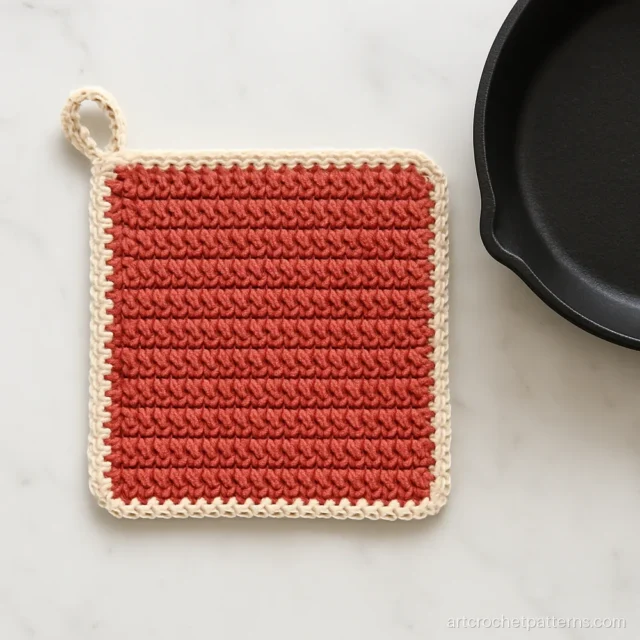 LevelBeginnerYarnWorsted cottonHook5 mm (H-8)
Double thick square in red and cream
Two panels of plain single crochet give the most heat protection a beginner can make. The cream joining round doubles as trim.
Maker note: Keep your tension firm. If you can see light through the fabric when you hold it up, go down a hook size.
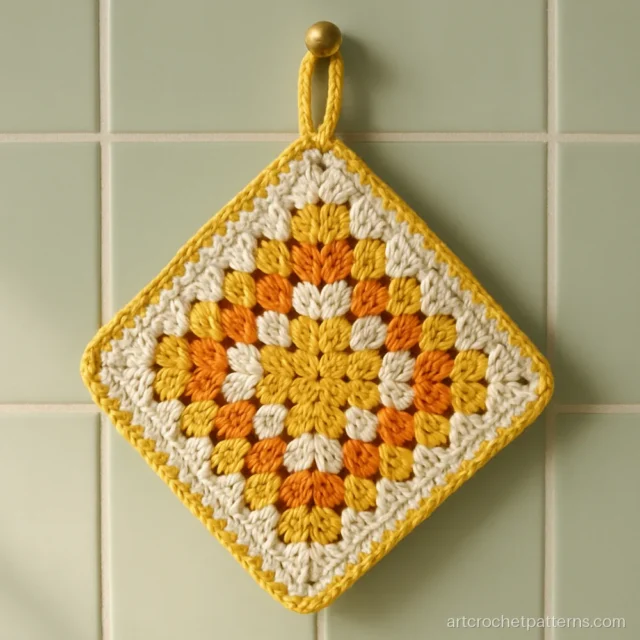 LevelEasyYarnWorsted cottonHook4.5 mm (7)
Granny square pot holder with backing
A granny square front looks cheerful, and a solid single crochet back panel blocks the heat that the gaps would let through.
Maker note: Never use a granny square alone; the chain spaces let heat straight through to your fingers.
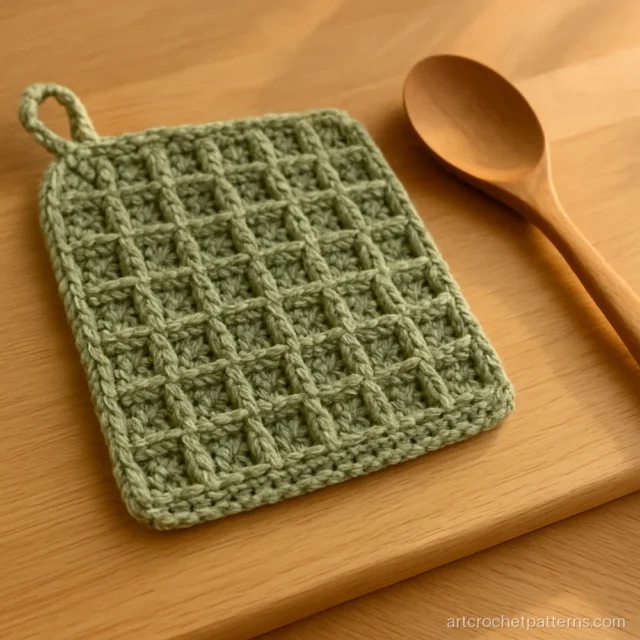 LevelIntermediateYarnWorsted cottonHook5 mm (H-8)
Waffle stitch potholder in sage
Waffle stitch builds a deep grid of post stitches that traps air, so one layer is nearly as thick as two.
Maker note: Waffle stitch pulls in a lot. Chain about 20 percent more than you would for single crochet.
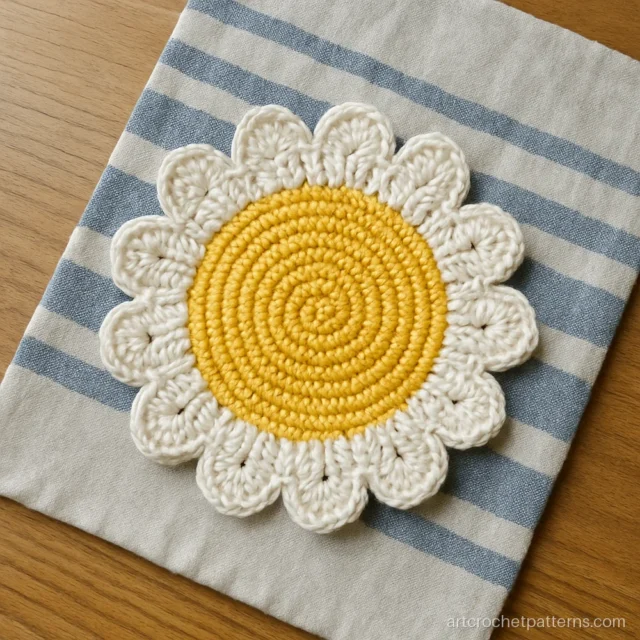 LevelEasyYarnWorsted cottonHook5 mm (H-8)
Round daisy hot pad
A round worked in spiral single crochet with a petal edge. Two circles sewn back to back make a sturdy hot pad for the table.
Maker note: Increase six stitches every round and keep the circle flat; check it on the table after each round.
 LevelEasyYarnWorsted cottonHook4.5 mm (7)
Corner to corner stripes in navy
Corner to corner tiles make diagonal stripes that look sharp in a set. This design is two layers, with the stripes running opposite ways.
Maker note: Bring in the new shade while closing the final tile, so each stripe begins crisp.
 LevelIntermediateYarnWorsted cottonHook5 mm (H-8)
Strawberry shaped potholder
A rounded triangle in red with a green leaf top and seeds embroidered in cream. It brings some fun to a plain kitchen.
Maker note: Embroider seeds on the front layer only, before you join the two layers, so the stitches stay hidden inside.
Why your crochet pot holder must be cotton
Read the fiber line on the yarn band before you buy. It should say 100 percent cotton. Blends that include acrylic, nylon or polyester can soften or melt near a burner or oven rack, even if most of the yarn is cotton.
- Cotton: handles heat, washes hot, and grips a pan handle.
- Wool: resists flame too, but it felts if you wash it hot. Fine for a trivet you rarely wash.
- Acrylic and other synthetics: never for a pot holder.
Thickness matters as much as fiber. A single layer of single crochet in worsted cotton is about a quarter inch thick. That is fine for a trivet, but for gripping a pan you want two layers or a deep stitch like waffle.
Free crochet potholder pattern: double thick square
Materials: about 120 yards of 100 percent cotton worsted yarn (two colors if you like), hook size 5 mm (H-8), a tapestry needle and scissors.
Gauge: a 4 inch patch holds 14 sc and 16 rows. Each panel measures roughly 7.5 inches per side. The turning ch 1 gives height only; never work into it.
Panels (make 2)
- Ch 27.
- Row 1: sc in 2nd ch from hook and in each ch across. (26)
- Rows 2 to 30: ch 1, turn, sc in each st across. (26)
- Fasten off the first panel. Leave the second panel on the hook.
Joining round and loop
- Hold the panels wrong sides together with the working panel in front. Work through both layers for the whole round.
- Rnd 1: ch 1, 3 sc in first st, sc in next 24 sts, 3 sc in last st, sc in each of the next 28 row ends, 3 sc in first ch of the foundation, sc in next 24 ch, 3 sc in last ch, sc in each of the next 28 row ends. (116)
- Sl st to first sc. Ch 12 for the loop, sl st in the same st. Fasten off.
Finishing: weave ends between the two layers so they disappear. You can work a second round of sc (with 3 sc in each center corner st) in a contrast color for a wider edge.
Yarn and hook choices for crochet pot holders
| Yarn weight | Hook | Result |
|---|---|---|
| DK cotton (3) | 4 mm | Thin; needs two layers plus a dense stitch |
| Worsted cotton (4) | 4.5 to 5 mm | The usual choice; firm and quick |
| Two strands of worsted cotton held together | 6.5 mm | Very thick single layer, a bit stiff |
| Bulky cotton (5) | 6 mm | Good for big oven mitt style pads |
Pick a hook a notch below what the band recommends. A pot holder should feel almost stiff when you first finish it; it softens with use and washing.
Stitches that block heat best
Tall, open stitches leave gaps. Pick stitches that pack yarn close together:
- Single crochet: tight and flat, the safest basic choice.
- Waffle stitch: post stitches that form deep cells.
- Moss or linen stitch: a woven look from single crochets split by chains; use two layers.
- Thermal stitch: each sc goes through the back loop of the next stitch and the front loop of the stitch just below it in the previous row, making a very dense double fabric.
The stitch library walks through each of these. A dishcloth stitch can look similar, but the cloths on the dishcloth patterns page are made to be thin and soak up water, so do not swap one for the other.
Pot holder crochet pattern troubleshooting
| You notice | Reason | What to do |
|---|---|---|
| Heat comes through in spots | Hook too big, or stitches too open | Drop a hook size and add a second layer |
| Square slants after washing | Cotton relaxes and shows uneven tension | Block it damp and pin it square to dry |
| Edges wave on the joining round | Extra stitches packed into the side edges | Skip a row end every so often to keep 28 per side |
| Loop stretches long | A plain chain loop sags with weight | Work sc back along the 12 chains for a firm loop |
Matching sets and care
Pot holders sell and gift well in sets of two with a matching towel. A towel holder that buttons onto the oven door and a pair of coasters make a full kitchen bundle in the same cotton.
Machine wash cotton pot holders in warm or hot water and tumble dry; they shrink a little the first time, so plan for that in your size. Retire one when it gets a scorch mark or a thin spot, because worn fabric conducts heat fast.
Questions makers ask
Is acrylic ever okay for a crochet potholder?
No. Acrylic is a plastic fiber that can melt when it touches a hot pan or oven rack, and melted fiber sticks to skin. Use 100 percent cotton, or wool for an item you will not wash hot.
How thick should crochet pot holders be?
Aim for about half an inch, which usually means two layers of single crochet in worsted cotton or one layer of a deep stitch like waffle. Test it on a warm pan before relying on it with a hot one.
What is the easiest potholder crochet pattern for a beginner?
Two plain sc squares stitched together by one sc edging round. You only need chain, single crochet and slip stitch, and the joining round hides small edge mistakes.
Are granny square potholders safe?
Only with a solid back layer. The chain spaces in a granny square let heat pass through, so add a single crochet panel behind it or sew two squares back to back.
How much cotton yarn does a crochet pot holder pattern use?
A double thick 7.5 inch square uses about 120 yards of worsted cotton. Single layer designs in waffle stitch use around 90 to 110 yards because the post stitches take extra yarn.
Why does my potholder curl at the corners?
A snug starting chain pulls the bottom edge in. Make that chain on a 5.5 mm hook, or begin with foundation single crochet instead. Blocking flat after washing also helps.