
Crochet dishcloth patterns are the best first projects in the kitchen, and below sits a full grit stitch dishcloth with six designs that scrub, wipe and dry well. A dishcloth is small, it uses one ball of cotton, and nobody minds if the edges are not perfect.
The grit stitch is our pick for a simple crochet dishcloth pattern. Every pair sets a short sc and a tall dc side by side in one stitch. The short and tall stitches lean against each other and leave a bumpy surface that grabs dried food better than a flat cloth. Chains, sc and dc are the whole toolkit. Brand new? The lessons in how to crochet teach all three.
At a glance
Skill level
BeginnerYarn
Worsted (4) cottonHook
5 mm (H-8)Stitches used
ch, sc, dcSize
About 8 by 8 inchesTime
1 to 1.5 hours
6 crochet dishcloth patterns designs to make
Every design lists the skill level, yarn and hook, with a note from the maker.
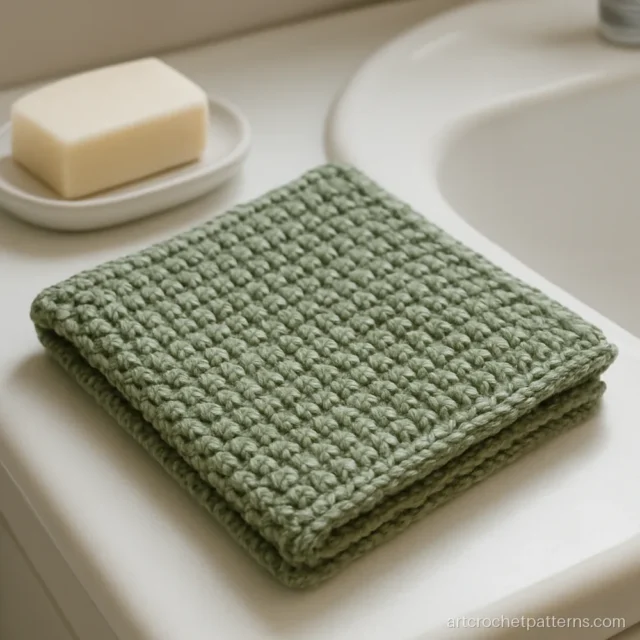 LevelBeginnerYarnWorsted cottonHook5 mm (H-8)
Sage grit stitch dishcloth
Our written pattern in sage. Grit stitch makes a textured, firm cloth that still folds easily in the hand.
Maker note: Each row starts and ends the same way. Count 16 pairs every row and you cannot go wrong.
 LevelEasyYarnWorsted cottonHook5 mm (H-8)
Thick cream waffle cloth
Post stitches build deep waffle squares. The thickest cloth here, good for scrubbing pans or drying dishes.
Maker note: Waffle stitch eats about 50 percent more cotton. Start with a full ball, not a scrap.
 LevelBeginnerYarnWorsted cottonHook4.5 mm (7)
Coral and white striped moss cloth
Moss stitch in two row stripes. The flat, woven look wipes counters cleanly and shows off color changes.
Maker note: Let the resting color ride loosely along the edge; the border hides it.
 LevelEasyYarnWorsted cottonHook5 mm (H-8)
Granny square dishcloth
A granny square grown to 7 inches makes a cheerful cloth. The open clusters dry fast between uses.
Maker note: Work six or seven rounds. Leave out the side chains between clusters for a denser cloth.
 LevelEasyYarnCotton and scrubby yarnHook5 mm (H-8)
Round scrubby with a poly center
A circle of cotton with a few rounds of scrubby polyester yarn in the middle. One side wipes, the center scrubs.
Maker note: Scrubby polyester yarn is hard to see. Work it in sc only, by feel, and count often.
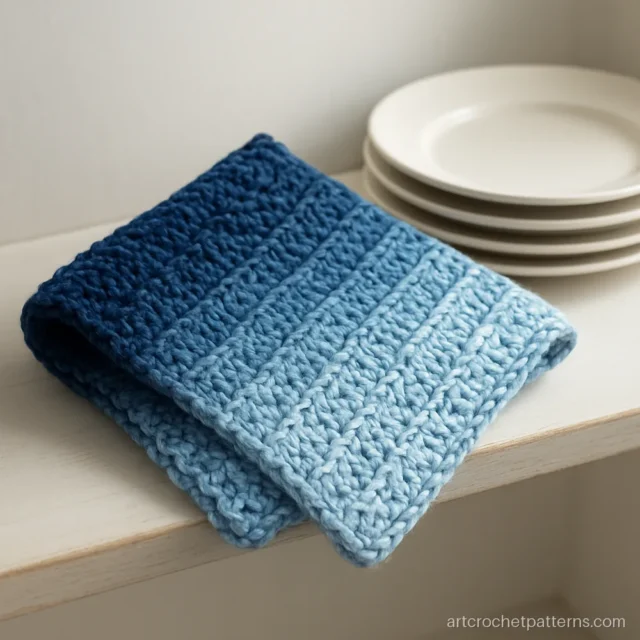 LevelEasyYarnOmbre worsted cottonHook5 mm (H-8)
Corner start dishcloth in blue ombre
Started at one corner and grown on the diagonal, then shrunk back down. A self striping cotton does the color work for you.
Maker note: Add a stitch on both edges, row after row, until a side hits 8 inches, then reverse with decreases.
Grit stitch crochet dishcloth pattern
You need: 60 to 75 yards (one ball) of worsted (4) cotton, an H-8 hook in 5 mm, and a yarn needle.
Size: about 8 inches square with the edging. Gauge is loose for a dishcloth, but aim for about 16 stitches over 4 inches.
Notes: A pair means (sc, dc) worked together in one stitch. Each turn begins with ch 1, which only lifts the yarn and never counts. Every row has 16 pairs and 1 sc, which is 33 stitches.
- Foundation: ch 34.
- Row 1: (sc, dc) in 3rd ch from hook, *sk next ch, (sc, dc) in next ch; rep from * to last ch, sc in last ch (16 pairs, 1 sc: 33 sts)
- Row 2: ch 1, turn, (sc, dc) in first sc, *sk next dc, (sc, dc) in next sc; rep from * to last 2 sts, sk next dc, sc in last sc (33 sts)
- Rows 3 to 26: rep Row 2, or work until the piece is about 7.5 inches long.
- Edging: ch 1, turn the piece to work down the side, sc evenly around all four sides with 3 sc in each corner, join with sl st to the first sc. Fasten off.
Row 2 has one rule: your hook goes into each pair's sc, and its dc gets skipped. As you work across, you meet each pair's tall dc first and its short sc second. Want a hanging loop? Before you fasten off, ch 10 and sl st back into the corner.
Cotton for a crochet dishcloth
| Cotton type | Hook | In the kitchen |
|---|---|---|
| Worsted cotton (4) | 4.5 or 5 mm | The classic: absorbent, easy to replace, washes hot |
| DK cotton (3) | 4 mm | Thinner, softer, dries faster; add 6 stitches to the chain |
| Cotton and linen blend | 4.5 mm | Crisp, strong, gets softer with each wash |
| Recycled cotton | 5 mm | Slightly uneven, rustic, very absorbent |
| Scrubby polyester | 5 mm | Not absorbent; use for scrubbing panels only |
Skip acrylic for dishcloths. Acrylic smears spills rather than absorbing them, and a hot pan can scorch or soften it. Our cotton yarn guide compares mercerized, unmercerized and recycled kinds.
How to crochet a dishcloth: tips for beginners
- Keep the starting chain relaxed, since a snug one pinches the bottom edge.
- After each row, count your stitches or pairs. Fix a mistake right away, while it is only one row.
- Turn your work the same way every time, toward you or away, so the edges look even.
- Check the length by folding one corner up to the opposite side. When it makes a neat triangle, the cloth is square.
- Weave ends in diagonally. Hot washes and wringing will work a straight end loose.
A dishcloth is also a fine practice square for blanket stitches. Make one in any stitch from crochet stitches to see how it looks before you commit to a whole throw.
Stitches that make good dishcloths
| Stitch | Texture | Use |
|---|---|---|
| Grit stitch | Bumpy and firm | Everyday dishes |
| Moss stitch | Flat, woven | Wiping counters |
| Waffle stitch | Thick, deep grid | Pots and drying |
| Single crochet in BLO | Ridged rows | Gentle scrub |
| Granny clusters | Open and light | Quick drying |
If you want something softer for the bath, the crochet washcloth pattern page uses gentler stitches for skin.
Dishcloth slip ups, sorted
| Mistake | What happened | Fix |
|---|---|---|
| Cloth gets wider | Worked into the dc of a pair | Only the sc of each pair gets the next (sc, dc) |
| Cloth gets narrower | Missed the last sc | Every row closes on a lone sc; look for it before turning |
| Cloth is a rectangle | Rows shorter than stitches are wide | Add rows until the fold test makes a square |
| Edges wavy after the border | Side edges got crowded | Work about 3 sc for every 4 row ends |
Care and keeping dishcloths fresh
Rinse and wring a dishcloth after use and hang it to dry so it never sits damp. Wash cloths in hot water with your towels and tumble dry. New cotton often tightens up in its first hot wash, so finish one cloth, launder it, and check its size before you make a set. Replace a cloth once it thins or stays stained. A stack of three tied with twine, plus a crochet potholder, makes a useful hostess gift. Find more kitchen and living room makes under blankets and home.
Questions makers ask
Why do crochet dishcloths always call for cotton?
Cotton soaks up water, survives hot washes and will not melt near a stove. Worsted weight is the usual pick, with cotton and linen blends a sturdy second.
Will one ball make a whole dishcloth?
Yes. The 8 inch grit stitch cloth uses only 60 to 75 yards, and many balls hold more than that. Waffle and puff stitches can take half again as much.
What is the easiest crochet dishcloth for beginners?
A plain single crochet square or the grit stitch on this page. Both use one row repeated and simple stitches.
Are crochet dishcloths sanitary?
Yes, if you let them dry between uses and wash them hot often. Keep several in rotation so each one dries fully.
What size should a dishcloth be?
Most are 7 to 9 inches square. Smaller cloths dry faster; larger ones are easier to wring out over a sink.
Can I use a dishcloth pattern for a washcloth?
Yes, though you may want a softer stitch and a softer cotton for skin. The grit stitch is a little rough for a face.