
A crochet steering wheel cover keeps a wheel from getting scorching hot in summer and icy in winter, and it adds a bit of color to the car. The version here is not a loose tube that slides around. It is made as tight cotton strips, one for each section between the spokes, and laced on so it grips the wheel like a second skin.
Safety comes first with this project. Read the checks below before you sew it on, and test it in a parked car before you drive.
At a glance
Skill level
EasyYarn
Worsted (4) cotton, about 130 yardsHook
4.5 mm (7)Time
3 to 4 hours plus lacingStitches used
ch, sc, whip stitchFits
Any wheel; you measure each section
6 crochet steering wheel cover designs to make
Every design lists the skill level, yarn and hook, with a note from the maker.
 LevelEasyYarnWorsted (4) cottonHook4.5 mm (7)
Charcoal laced strip cover
The written pattern: dense single crochet strips, one per section, whip stitched closed on the inside of the rim. Dark cotton hides hand marks.
Maker note: Make each strip a little shorter than the section so it stretches tight. A snug strip never slides when you turn.
 LevelEasyYarnWorsted (4) cottonHook4.5 mm (7)
Cream cover with flat daisies
Tiny flat daisies are sewn onto the outer rim only, where hands do not rest. Keep them flat so nothing catches on a sleeve.
Maker note: Sew motifs on before lacing the strip to the wheel. It is much easier on a flat piece.
 LevelEasyYarnWorsted (4) cottonHook4.5 mm (7)
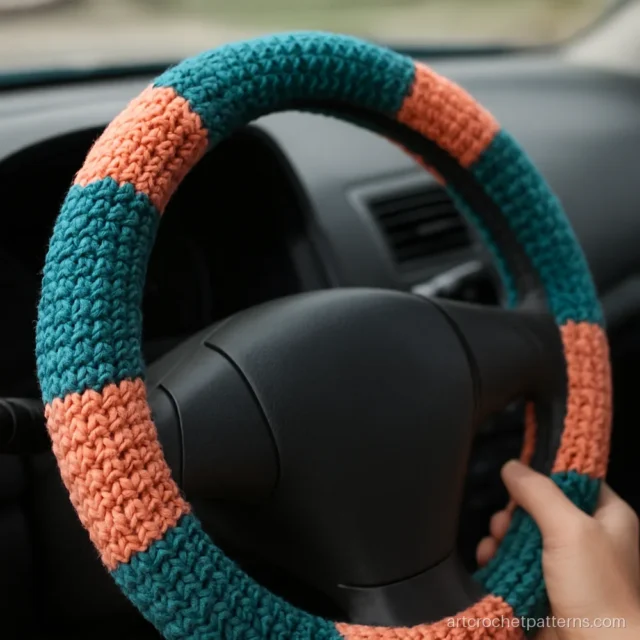
Teal and coral stripes
Change color every 4 rows for stripes that wrap around the grip. Short stripes look tidy because they line up on each side of the seam.
Maker note: Let the resting color travel up along the edge. It ends up inside the seam, so there are no tails to weave in.
 LevelEasyYarnDK (3) cottonHook4 mm (G-6)
Olive moss stitch grip
Moss stitch gives a slightly textured surface that feels secure under the palms. It stays thin, which matters on a wheel.
Maker note: Work an odd number of stitches across so both long edges start and end with sc. That gives a clean seam.
 LevelIntermediateYarnWorsted (4) cottonHook4.5 mm (7)
Black and white check
Tapestry crochet in blocks of 3 stitches by 3 rows creates a small check. The carried yarn makes the fabric thicker, so plan a slightly wider strip.
Maker note: Check the finished thickness. If the grip feels bulky in your hands, switch to plain stripes.
 LevelEasyYarnWorsted (4) cottonHook4.5 mm (7)
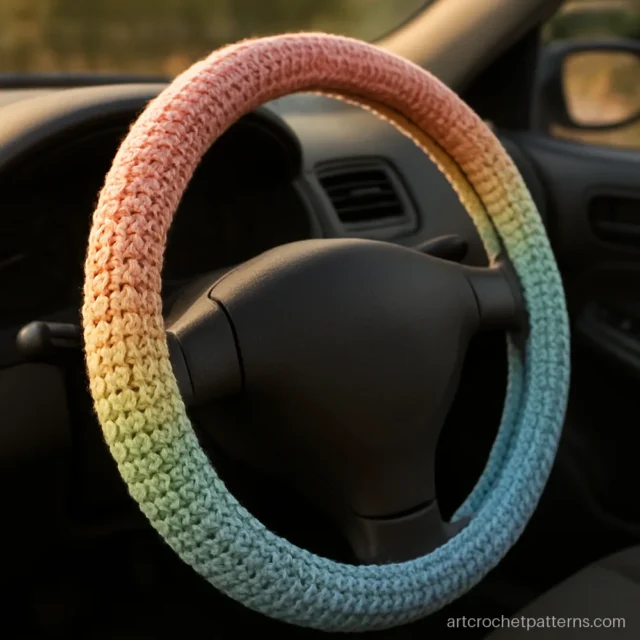
Soft rainbow ombre cover
Each section is a different shade, moving through pink, peach, yellow, mint and blue. Using one shade per strip keeps color changes at the spokes.
Maker note: Lay all strips out in order before lacing so the shades flow the right way around the wheel.
Safety checks before you drive
- Work only on the outer rim, never across the center.
- Use smooth, flat stitches. No bobbles, puffs, pom poms, beads or dangling ties.
- Lace it on in a parked car, then grip and twist hard in both directions. Nothing should move.
- Keep it thin. A grip that is much fatter than the original can tire your hands.
- Some cars sense hands on the wheel or heat the rim. Check your vehicle manual; a thick cover can interfere with these features.
- Inspect it every few weeks. Cotton can loosen with heat and sun, so re lace or replace it when it feels slack.
Measuring the wheel
- Grip around: circle the rim itself with a flexible tape. Most are 4 to 4.75 inches around.
- Section lengths: measure along the outer edge of the rim from one spoke to the next. A three spoke wheel has three sections, often two short side pieces and one long top piece.
- Make it snug: take roughly a quarter inch off the grip number for strip width, and about 1 inch from each section length.
Cotton has very little stretch, so these small subtractions matter. They turn a loose sleeve into a tight one.
Crochet steering wheel cover pattern: laced strips
Materials: about 130 yards worsted cotton, 4.5 mm hook, yarn needle, stitch markers. Gauge: 16 sc and 18 rows = 4 inches. Sample size: strips 4.25 inches wide for a 4.5 inch grip. Ch 1 at the start of rows does not count.
- Foundation: ch 18.
- Row 1: sc in 2nd ch from hook and in each ch across, turn (17)
- Row 2: ch 1, sc in each st across, turn (17)
- Rows 3 on: repeat Row 2 until the strip is 1 inch shorter than the section it will cover. Fasten off, leaving a tail 4 times the strip length for lacing.
- Make one strip for each section of the wheel.
Fitting: Wrap a strip around its section with the seam on the inner edge of the rim, the side facing the center. Thread the long tail on a yarn needle. Whip stitch the two long edges together, pulling firmly every few stitches so the strip stretches tight. At each spoke, sew the short end of the strip to itself with three or four stitches so it cannot creep. Never tie or glue anything to the spokes or the center.
New to joining edges? The whip stitch guide shows the move.
Choosing yarn for a firm grip
| Yarn | Hook | How it drives |
|---|---|---|
| Worsted cotton | 4.5 mm | Grippy and washable; best choice |
| DK cotton | 4 mm | Thinner, closest to the bare wheel |
| Acrylic | 5 mm | Can feel slick and stretches loose in heat |
| Chenille or fuzzy yarn | Any | Avoid; slippery and sheds |
Cotton is also the coolest fiber to touch on a hot day. Read more about it in the cotton yarn guide.
Fit problems and fixes
| Sign | What it means | Fix |
|---|---|---|
| Cover rotates when you turn | Strip too wide or lacing too loose | Remove 1 or 2 stitches of width and re lace tighter |
| Gap at a spoke | Strip too short | Add 2 rows and sew the end down firmly |
| Bunching on the inner rim | Strip too long for the inside curve | Rip back 2 rows; the inside edge is shorter than the outside |
| Seam rubs the fingers | Seam on the front or top | Turn the strip so the seam sits on the inner edge |
More car and travel makes
If you like practical crochet for the road, try a water bottle holder for the passenger seat or a keychain for your car keys. Hang nothing from the mirror or the wheel that can swing into your view. Find more small makes in crochet accessories.
Questions makers ask
Are crochet steering wheel covers safe?
They can be, if they are tight, thin and never cover the airbag pad, the buttons or the levers. A cover that slips or bunches is not safe. Test it parked, twist hard, and remove it if it moves.
Why not crochet one long tube?
A tube must be loose enough to slide on, so it is usually loose enough to slide while driving. Strips laced on in place can be pulled tight, and the spokes stop them from creeping around the rim.
How much yarn does a steering wheel cover need?
Plan on roughly 130 yards of worsted cotton for an ordinary car wheel, including the long lacing tails. Wheels on trucks and vans are larger, so allow about 160 yards.
Can I use acrylic yarn?
It is not ideal. Acrylic is smoother than cotton and can grow loose in a hot car. If you use it, make the strips extra snug and check them often.
How do I take the cover off?
Snip the whip stitch seam on the inner edge with small scissors and unwrap each strip. Pull out the cut lacing yarn and the strips are ready to wash or re lace.