
Finger crochet swaps the hook for your own index finger, so you pull loops of thick yarn through with your hand. It is the same craft as hook crochet, with the same chains and single crochet, just scaled up to jumbo yarn and big, squishy stitches.
It is a fun way to start, great for kids and anyone whose hands get tired holding a small hook. In an hour or two you can make a chunky scarf, a garland or the start of a plush blanket. Below are the steps for a finger chain and finger single crochet, how to choose yarn, a simple scarf pattern and the fixes for stitches that grow too big.
At a glance
Skill level
BeginnerTools
Your hands and scissorsYarn
Jumbo (7) or super bulky (6)Stitches used
Slip knot, chain, scTime
1 to 2 hours for a scarfAlso called
Hand crochet
Yarn for finger crochet
Your finger makes a stitch about as wide as the finger itself, so the yarn must be thick enough to fill it. Thin yarn gives loose, holey stitches that fall apart.
| Yarn | Fit for fingers | Best use |
|---|---|---|
| Jumbo (7) chenille or plush | Excellent, soft and fast | Hand crochet blankets, cushions |
| Jumbo (7) wool roving style | Very good, airy look | Scarves and throws, light use only |
| Super bulky (6) acrylic | Good, tighter stitches | Scarves, cowls, headbands |
| Bulky (5) held double | Works if held as two strands | Practice and small pieces |
| Worsted (4) single | Too thin | Use a hook instead |
Unspun roving pills and pulls apart with heavy use, so keep it for pieces that sit on a bed or sofa. For more on fibers and weights, see our crochet yarn guide.
How to finger crochet a chain
- Tie a slip knot, then wear its loop on the index finger of your dominant hand. Leave a 6 inch tail.
- Hold the working yarn in your other hand, running over that hand's index finger.
- With the looped finger, reach forward, hook the working yarn and pull it back through the loop. That is one chain.
- Slip the new loop onto your finger and adjust it so it is about the width of two fingers.
- Repeat until you have the number of chains you need. Count the V shapes on the front, not the loop on your finger.
Left as it is, a long finger chain can be a garland, a belt or a gift tie. The same counting rules apply as with a hook, covered in our guide to starting a crochet chain.
In pictures
What the work should look like, with the yarn and hook used for each sample.
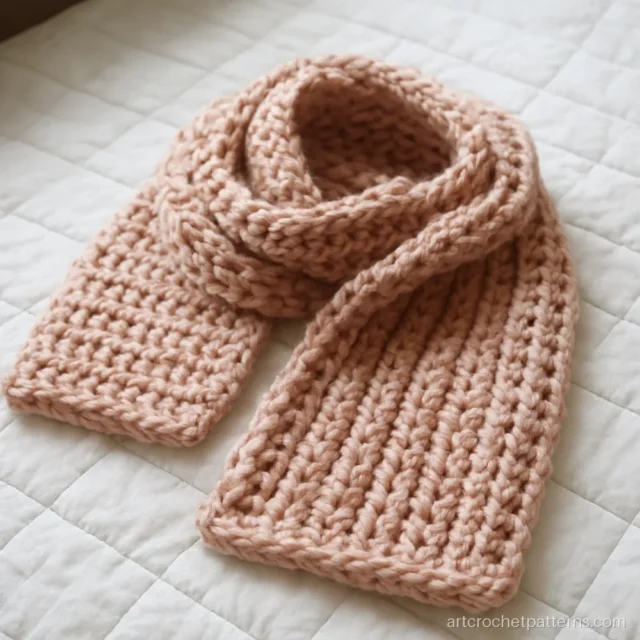 LevelBeginnerYarnJumbo acrylicHookFingers only
Chunky finger crochet scarf
Ten stitches wide in jumbo yarn, this scarf grows by about an inch every row. Full instructions follow in the scarf section.
Maker note: Keep the loop on your finger snug but loose enough to slide off. Pinched loops make the next row hard to enter.
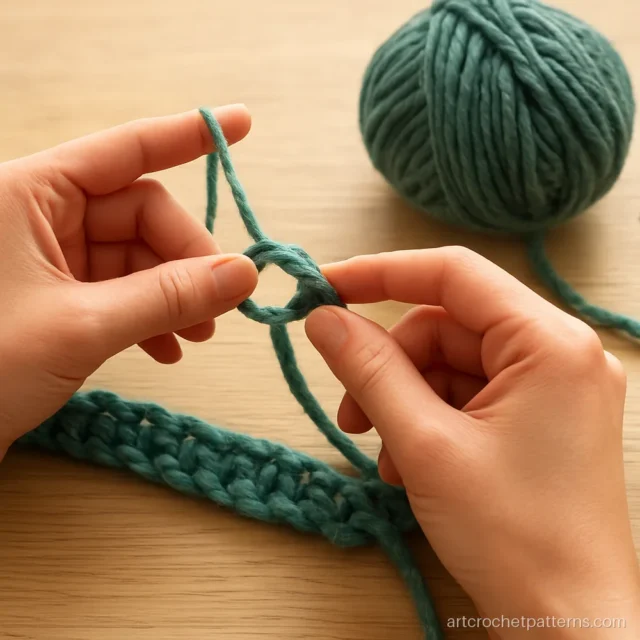 LevelBeginnerYarnSuper bulky woolHookFingers only
Making a finger chain
The index finger acts as the hook, reaching through the loop to grab the yarn and pull a new chain through.
Maker note: Pull each chain to about the width of two fingers. Tiny chains fight back when you try to sc into them later.
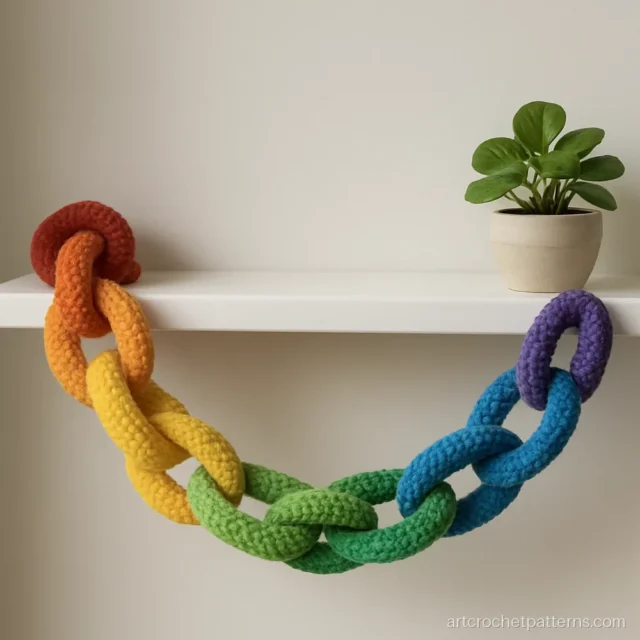 LevelBeginnerYarnJumbo chenilleHookFingers only
Rainbow finger chain garland
A plain finger chain in color-changing chenille makes a soft garland for a shelf or a door frame. It is a good first project.
Maker note: Chenille hides mistakes, so it is forgiving for chains. It is harder to rip out, so go slowly.
How to crochet with your fingers: single crochet
- Skip the first chain next to your finger. Poke your index finger through the second chain, entering from the front.
- Catch the strand coming from the ball and draw it out through that chain, leaving a pair of loops around your finger.
- Grab the working yarn again and pull it through both loops. One sc made.
- Move to the next chain and repeat until no chains are left.
- To turn, chain 1, flip the piece over like a page, and work one sc in each stitch of the row below, putting your finger under both loops at the top of each stitch.
It helps to hold the loop on your finger with your thumb while you reach for the yarn, so it does not slide off. If it does fall off, pick it up right away before the stitch below unravels.
Finger crochet scarf pattern
A chunky scarf about 8 inches wide and 55 inches long, a nice size for a teen or adult.
Yarn: about 70 yards of jumbo (7) acrylic or chenille. No hook needed, just scissors.
- Make a slip knot on your finger and finger chain 11.
- Row 1: Sc in the 2nd ch from your finger and in each ch across. Turn. (10)
- Row 2: Ch 1 (does not count), sc in each st across. Turn. (10)
- Rows 3 on: Rep Row 2 until the scarf is 55 inches long, or as long as you like.
- Cut the yarn, leaving an 8 inch tail. Pull the tail all the way through the last loop to lock it.
Weave each tail through 4 or 5 stitches by hand. Jumbo yarn is too thick for most needles, so your fingers do the weaving too. For a bigger plush piece, our hand crochet blanket page works the same stitch across 40 or more stitches.
When hand crochet stitches misbehave
| Trouble spot | Reason | Quick cure |
|---|---|---|
| Stitches get bigger and bigger | Loops left loose on the finger | Tug the working yarn after each stitch to match the last one |
| Edges slant in | Last stitch skipped at the row end | Count stitches every row; the last one hides under the chain |
| Piece twists | Turning the work a different way each row | Always flip it the same way, like turning a page |
| Holes between rows | Yarn too thin for fingers | Use jumbo yarn or hold two strands together |
| Fingers ache | Gripping the loop hard | Rest every 15 minutes and keep the loop relaxed |
Finger crochet vs hook crochet and finger knitting
Finger crochet is real crochet. The stitches have the same names and structure; only the tool changes. A hook gives smaller, firmer stitches and lets you use any yarn, while fingers are quicker for huge yarn and need no tools. Finger knitting is different: it wraps yarn around several fingers at once and makes a tube or cord, not crochet stitches.
Many makers start with fingers, then move to a jumbo hook once they want neater edges. If you are ready for that step, our how to crochet lesson covers holding a hook from the very start, and crochet for kids has more first projects.
Care for hand crocheted pieces
Wash by the yarn label. Many jumbo chenille yarns can go in a gentle cold cycle inside a pillowcase and then dry flat; wool roving should be hand washed only, if at all. Big stitches can catch on rings and zips, so pull any snag back to the inside with your fingers rather than cutting it. Store chunky pieces folded, not hanging, so the stitches do not stretch.
Questions makers ask
Can you crochet with just your fingers?
Yes. Your index finger does the job of the hook, pulling loops through to make chains and single crochet. It works best with jumbo or super bulky yarn.
What yarn is best for finger crochet?
Jumbo weight 7 yarn, especially chenille or plush, is easiest. Super bulky 6 yarn works too but makes tighter stitches. Worsted yarn is too thin to use with fingers unless you hold several strands together.
Is finger crochet good for kids?
It is a great first craft for kids who can follow a few steps, because there is no sharp tool and each stitch is as big as a grape. Start with a finger chain, then try a short scarf.
How do I keep my finger crochet stitches even?
Size each loop against your finger, about two fingers wide, and give the working yarn a small tug after every stitch. A quick count after every row keeps the edges from drifting.
What yardage does a finger crochet blanket take?
Expect something like 200 to 400 yards of jumbo yarn for a throw about 40 by 50 inches, depending on how thick it is. Thicker plush yarns use less length but weigh more, so check the yardage on each skein.