
Freeform crochet means making fabric without a fixed pattern, joining small shapes of different stitches, colors and textures into one piece, and here you get three written motifs to start with, a method for joining them and six ideas to make. The finished patch is called a scrumble. Many scrumbles sewn together become a bag, a vest, a wall hanging or a whole coat.
Nothing has to match. That freedom scares some makers at first, so this page gives you a few rules of thumb to lean on until you trust your eye.
At a glance
Skill level
Easy to advanced, it grows with youStitches used
Any; start with sc, hdc, dc and bobblesYarn
Scraps of similar weight, mixed fibersHook
4 to 5 mm for worsted scrapsPiece name
Scrumble (one patch of joined motifs)Time
1 to 3 hours per palm sized scrumble
6 freeform crochet designs to make
Every design lists the skill level, yarn and hook, with a note from the maker.
 LevelEasyYarnWorsted wool scrapsHook4.5 mm (7)
Ocean blues scrumble
Seven shades of blue and green with one spark of coral. A ruffled circle, curved leaves and a bobble cluster share one patch.
Maker note: Limit yourself to one color family plus a single accent. It looks planned even when it was not.
 LevelIntermediateYarnMixed worsted scrapsHook4.5 mm (7)
Autumn scrumble shoulder bag
Four scrumbles joined into a flat panel, folded and lined. Rust, ochre, olive and plum feel like fallen leaves.
Maker note: Sew a fabric lining inside. Freeform fabric has thin spots that let small items slip through.
 LevelIntermediateYarnWorsted and DK cottonHook4 mm (G-6)
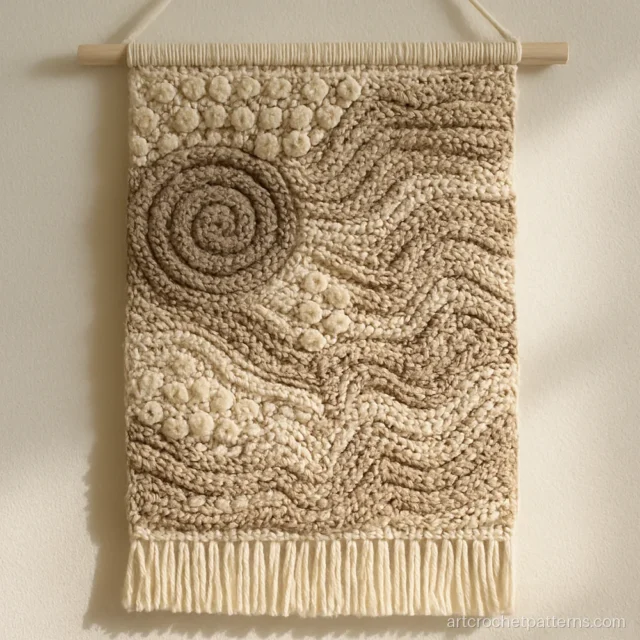
Neutral wall hanging
All texture and no color: cream, oat and taupe cotton let the raised stitches speak. It hangs from a sanded branch.
Maker note: Lightly steam block before hanging so the scrumbles settle and the edges stop curling.
 LevelBeginnerYarnSport weight woolHook3 mm
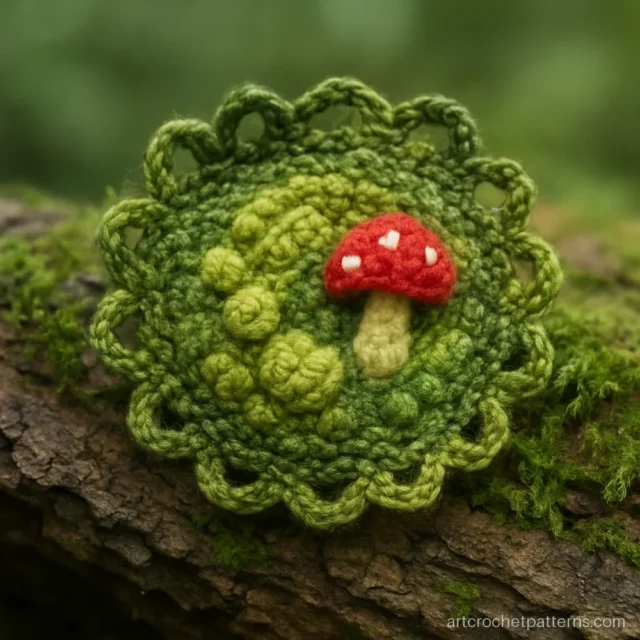
Moss garden brooch
A palm sized scrumble backed with felt and a pin. It is the quickest way to try freeform without a big plan.
Maker note: Glue felt to the back and sew the pin through the felt, not the crochet, so it stays firm.
 LevelAdvancedYarnDK wool and mohairHook4 mm (G-6)
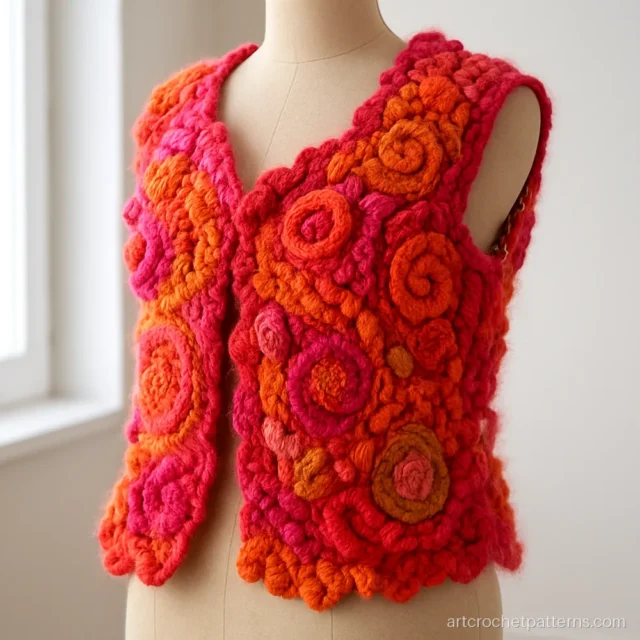
Sunset scrumble vest
Scrumbles grown to fit a paper template of a vest, then joined at the shoulders. Fuchsia shading to gold.
Maker note: Pin scrumbles onto a paper template cut from a vest you already own, and fill the gaps last.
 LevelEasyYarnWorsted acrylic scrapsHook5 mm (H-8)
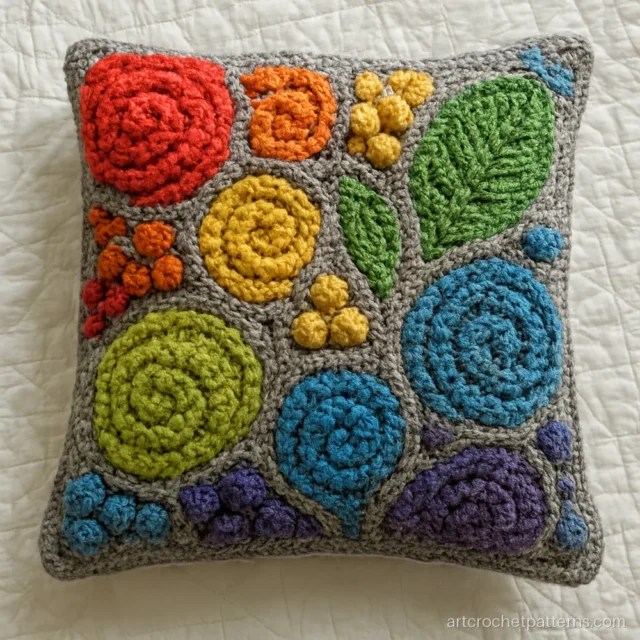
Rainbow scrap pillow
Every leftover ball from a year of projects in one pillow. A gray filler stitch around each motif calms the rainbow.
Maker note: Use one neutral as the filler between bright motifs; it ties a scrap pile together.
How freeform crochet works
Most pieces follow the same loose cycle, repeated until the scrumble is the size you want.
- Start with a focal motif. A spiral, a ruffled circle or a big bobble cluster. It sets the color and mood.
- Add shapes around it. Leaves, ridged strips, small circles. Sew them on or crochet them straight onto the edge.
- Fill the gaps. Work short rows of sc or hdc into the edge of the patch, turning wherever the shape needs filling. Stop a row early to shape a curve.
- Change something. New color, new stitch height or a new direction each time you add a piece.
- Check the outline. When the scrumble is roughly round or roughly square, it is easy to join to the next one.
Turn the piece often. You are not working rows from one edge to the other, so look at it from all sides and build wherever it looks thin.
Three motifs for a first freeform crochet scrumble
These three shapes give you contrast in height, outline and texture. Work them in worsted scraps.
Materials: worsted scraps in 4 to 6 colors (about 10 yards each), a 4.5 mm (7) hook, a tapestry needle, stitch marker. Finished scrumble about 6 to 7 inches across.
Motif A, ruffled circle. Worked in a spiral; move the marker up each round.
- Rnd 1: 6 sc in a magic ring (6).
- Rnd 2: 2 sc in each st (12).
- Rnd 3: (sc, 2 sc in next st) 6 times (18).
- Rnd 4: change color, working in front loops only, 3 dc in each st (54). Sl st in next st and fasten off. The back loops of Rnd 3 stay free for joining.
Motif B, curved leaf.
- Ch 11. Skip the first ch from the hook; you now work the 10 remaining chains.
- Side 1: sc in next ch, hdc in next ch, dc in next 5 ch, hdc in next ch, sc in next ch, 3 sc in last ch (12).
- Side 2, along the other side of the chain: sc in next ch, hdc in next ch, dc in next 5 ch, hdc in next ch, sc in last ch (9). Sl st to first sc (21 sts). Fasten off.
Motif C, bobble cluster. Bobble = 5 dc in one st, each left with 2 loops on the hook, then yo and pull through all 6 loops.
- Ch 2, 6 sc in 2nd ch from hook, sl st to first sc (6).
- Rnd 2: ch 1, (sc, bobble) in each st around, sl st to first sc (6 sc, 6 bobbles). Fasten off.
Joining and filler.
- Sew Motif B against the edge of Motif A, curving it around the ruffle. Sew Motif C into the angle between them.
- Join a neutral color at any edge. Work sc into the outer edge of all three pieces, turning when the shape asks for it. Work 2 sc in one st on outer curves and sc2tog on inner curves.
- Keep adding short rows until the outline is roughly round. Fasten off and weave in.
The leaf curls when the dc section is placed against the ruffle, so let it bend rather than flattening it. If the scrumble starts to cup, add extra stitches on its outer edge; if it ruffles, skip a few.
Choosing yarn for freeform pieces
| Yarn mix | Hook range | Effect |
|---|---|---|
| All worsted, one fiber | 4.5 to 5 mm | Even fabric, easy to join, good first scrumble |
| Worsted plus DK | 4 to 4.5 mm | Fine motifs sit beside bold ones |
| Wool plus a little mohair | 4 mm | Soft halo that blends seams |
| Cotton plus bouclé | 4.5 mm | Strong contrast of smooth and bumpy |
| Chunky accents | 6 mm for that motif only | Bold 3D shapes for wall art |
Mixing weights is part of the fun, but plan for it. Use a larger hook for thick yarn and a smaller one for thin, so every motif lands near the same density. For wearable pieces, keep fibers close in washing needs.
Freeform rules of thumb
- Limit the palette. One family of colors plus one accent is enough.
- Repeat a color three times across the patch so the eye travels.
- Mix stitch heights. Tall dc beside flat sc creates shadows.
- Vary scale. One large motif, several medium ones, a few tiny bobbles.
- Leave gaps on purpose in wall art; fill them in garments and bags.
- Stop before it feels done. Busy edges are harder to join.
For stitches with strong texture, see bobble stitch and popcorn stitch. Irish lace is a close cousin: separate motifs joined with mesh, and the Irish crochet page shows how.
Fixing a scrumble that misbehaves
| What happens | Why | Way out |
|---|---|---|
| Scrumble curls up at the rim | The outer edge is short of stitches | Add 2 sc in one st every few stitches on curves |
| Edge waves like lettuce | Too many stitches added | Use sc2tog on the next filler row |
| Colors look muddy | Too many similar mid tones | Add one very light and one very dark scrap |
| Scrumbles will not join neatly | Outlines too jagged | Fill corners with short rows until each is roughly round |
| Back is lumpy | Ends knotted instead of woven | Weave every end into a motif of the same color |
Joining scrumbles into a bigger piece
Lay scrumbles on a paper template or a towel and nudge them until the gaps are small. Pin them. Sew the touching edges with a whip stitch in a neutral yarn, then fill remaining holes with small circles or short rows of filler worked straight into both edges. For flat panels like a blanket, the same thinking behind surface crochet works too: a line of slip stitches across a seam can turn a join into part of the design. Every stitch listed in the crochet stitches section can become one more freeform motif.
Questions makers ask
What is a scrumble in freeform crochet?
A scrumble is one patch of joined motifs and filler, usually palm to plate sized. Bigger pieces are made by joining several scrumbles, much like joining motifs for a blanket.
Is freeform crochet good for beginners?
It suits anyone who already knows sc, hdc and dc. Start with the three motifs above and a narrow color range. Mistakes simply become part of the texture.
Do I need a pattern for freeform crochet?
No. You work from motifs you know and decide where each one goes. Written motifs only give you building blocks; the layout is yours.
Can I mix knitting and crochet in a freeform piece?
Many makers do. Knitted strips or small swatches can be sewn in among crochet motifs. Match the yarn weight and sew them on with the same neutral filler yarn.
How do I wash a freeform crochet piece?
Follow the most delicate yarn in the piece. If any scrap is wool, hand wash cool and dry flat. Mixed scrap pieces often bleed, so test a damp white cloth on bright colors first.
How big should one scrumble be?
For a first piece, aim for about 6 to 8 inches across. Small enough to finish in an evening and big enough to see how colors interact.