
Alpine stitch crochet builds a deep, pebbly texture by placing front post double crochets around stitches two rows below, in a staggered layout. The raised posts sit like little bricks in a stone wall, and the fabric turns out thick, warm and reversible enough to use on blankets.
It is a four row repeat that uses only single crochet, double crochet and the front post double crochet. If you have tried front post double crochet once, this is a good next step.
At a glance
Skill level
IntermediateStitches used
Sc, dc, FPdcRepeat
4 rows, odd stitch countYarn
Worsted wool or acrylicHook
5 mm (H-8) to 5.5 mm (I-9)Good for
Blankets, beanies, scarves
How the alpine crochet stitch is built
The fabric alternates two kinds of rows. Wrong side rows are plain single crochet. Right side rows mix regular dc with FPdc worked around a dc two rows down, which means you reach past the sc row you just made.
Each FPdc row moves the raised posts over by one stitch. That shift is what makes the staggered brick look. Because the post stitch grabs a lower stitch, you skip the sc behind it on the current row so the count stays the same.
Designers publish small variations: some use FPtr, some put the posts in columns, some work an hdc base. The version below is a common, balanced one. If you follow a pattern, use its own stitch notes.
Alpine stitch crochet swatch, row by row
Grab a worsted ball and a 5 mm hook for this one. RS means right side. The stitch count stays at 21 the whole way.
- Ch 22.
- Row 1 (WS): Sc in 2nd ch from hook and in each ch across. (21)
- Row 2 (RS): Ch 2 (does not count), turn. Dc in each st across. (21)
- Row 3 (WS): Ch 1 (does not count), turn. Sc in each st across. (21)
- Row 4 (RS): Ch 2, turn. Dc in first st. *FPdc around the next dc 2 rows below, skip the sc behind it, dc in next st; rep from * across. (21: 11 dc and 10 FPdc)
- Row 5 (WS): Ch 1, turn. Sc in each st across. (21)
- Row 6 (RS): Ch 2, turn. *FPdc around the next dc 2 rows below, skip the sc behind it, dc in next st; rep from * to last st. FPdc around the last dc 2 rows below. (21: 10 dc and 11 FPdc)
- Rows 7 to 22: Rep Rows 3 to 6 four times. (21)
- Fasten off.
On Row 6, each FPdc lands around a plain dc from Row 4, so the posts sit between the posts of the row before. Keep the stitch count odd if you resize: any odd number works.
In pictures
What the work should look like, with the yarn and hook used for each sample.
 LevelIntermediateYarnWorsted woolHook5 mm (H-8)
Cream wool alpine swatch
A light, plain wool shows how each raised post sits between two posts in the band below.
Maker note: Swatch in a pale color first so you can see which stitch two rows down you are reaching for.
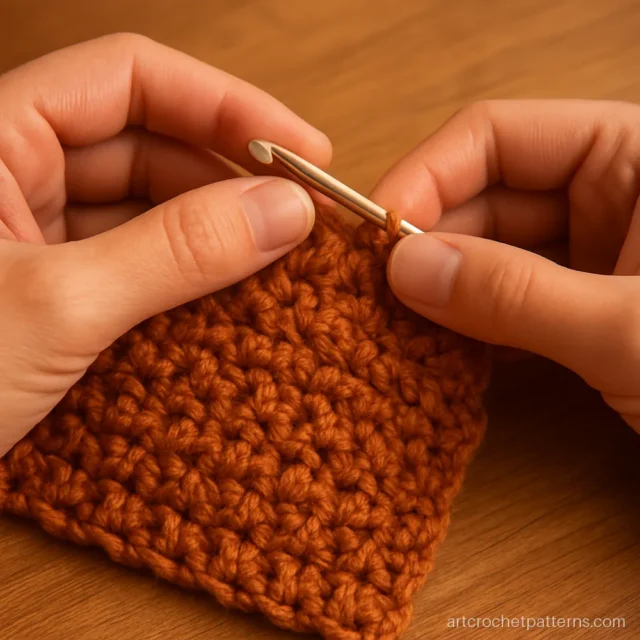 LevelIntermediateYarnWorsted acrylicHook5 mm (H-8)
Working the post two rows down
The hook travels around the post of the double crochet two rows below, from front to back to front.
Maker note: Pull the loop up long, to the height of the current row, or the fabric puckers.
 LevelIntermediateYarnAran acrylic blendHook5.5 mm (I-9)
Sage green alpine throw
The stitch is dense, so a throw turns out heavy and very warm. One solid color lets the texture lead.
Maker note: Plan about a third more yarn than a plain double crochet throw of the same size.
Making the front post double crochet in this stitch
- Yo once.
- Look two rows down, past the sc row, and find the dc you need. Push the hook in from the front, to the right of that post, behind it, and back out on its left.
- Yo and draw up a loop, lifting it to the height of the current row. You have 3 loops.
- Yo, pull through 2. Yo, pull through the last 2. The raised post now leans over the sc row like a bar.
- Skip the sc sitting behind the post, then work the next dc into the next sc as normal.
Left handed makers mirror the direction: in from the front on the left, out on the right.
Picking yarn and hook
| Yarn | Hook size | Fabric |
|---|---|---|
| DK wool | 4.5 mm | Firm and fine, for hats and mitts |
| Worsted acrylic | 5 mm | Washable, thick blanket texture |
| Aran wool blend | 5.5 mm | Heavy, very warm throws |
| Chunky | 6.5 mm | Bulky and stiff; best for rugs or cushions |
Smooth, plied yarn shows the texture best. The stitch eats yarn, so a worsted throw can use 30 to 40 percent more than plain double crochet. Pick soft yarn for items that touch skin, because this fabric is dense.
Lumps, bumps and other alpine trouble
| What happens | Likely reason | Sort it out |
|---|---|---|
| Count grows on RS rows | Forgot to skip the sc behind the post | Skip one sc for every FPdc |
| Fabric puckers | Post loop pulled up too short | Lift the loop to row height before finishing |
| Posts line up in columns | FPdc worked around a FPdc instead of a dc | Reach for the plain dc between the old posts |
| Edges uneven | Ch 2 turn sticks out | Pull the chain snug or use a stacked sc start |
Ideas for crochet alpine stitch projects
Use it for a beanie body with a plain ribbed brim, a thick scarf, a pot holder or a throw in one color. Bands of alpine texture between plain rows also look good on a sampler blanket. For other dense, warm fabrics, try waffle stitch or thermal stitch, and browse more in textured crochet stitches.
Questions makers ask
Is alpine stitch crochet hard?
The post stitch makes it a notch harder than plain rows, but the repeat is only four rows. If you can count to two rows down, you can do it.
Why does my alpine piece eat through yarn?
Every raised post curls around an older dc and doubles the fabric over on itself. That gives depth and warmth, and it also means more yarn per square inch.
Is the alpine stitch reversible?
The right side shows the raised bricks. The wrong side has a flatter, bumpy texture that still looks tidy, so a blanket in this stitch has no ugly back.
Can I make a blanket with this stitch?
Yes, it makes a warm, heavy blanket. Use an odd number of stitches, add rows in the 4 row repeat, and plan extra yarn.
What are the UK terms for the alpine stitch?
In UK terms the sc rows become double crochet and the dc and FPdc become treble and front post treble. The construction is the same.