
Thermal stitch crochet is a single crochet that grabs two loops from two different rows at once, so each new row locks onto the two below it. The result is thick, almost double layer fabric with very little stretch and no holes.
That density is the point. A thermal crochet stitch blocks wind on ear warmers, keeps heat off your hand in a potholder, and makes coasters that do not slide. On the front you see neat horizontal ridges, a bit like a woven mat.
You only need to know single crochet and where the front and back loops are. The back loop only guide helps if those loops are new to you.
At a glance
Skill level
Easy, a little slowStitches used
ch, sc through 2 loops of 2 rowsYarn
Worsted (4) cotton or woolHook
1 to 2 sizes larger than usualYarn use
About 1.5 times plain scGood for
Potholders, mitts, ear warmers, coasters
Thermal stitch crochet, one row at a time
Make a foundation chain of any length. You turn after every row, and the ch 1 that begins it is never counted.
- Row 1: starting in the second chain from your hook, sc into the back bump of each chain. This leaves the V of each chain free on top. Chain 1 and turn.
- Row 2, find the loops: look at the first stitch. You need its back loop and, right under it, the free loop of the chain below.
- Insert twice: slide the hook into the back loop of stitch one and carry on down through the nearer strand of the chain V. Both loops are now on the hook shaft.
- Finish the sc: wrap the yarn, draw it back through both loops, then wrap again and finish the sc as usual.
- Repeat: do the same in every stitch to the row end, then ch 1 and flip the work.
- Row 3 and up: every stitch pairs the back loop of the newest row with the spare loop one row further down. Patterns often call this the front loop of the row below.
Your stitch count stays the same on every row. After four rows, the fabric should feel firm and thick, like felt.
Practice swatch: a thermal potholder
This square makes a single layer potholder about 7 inches across in worsted cotton.
- Ch 26.
- Row 1: sc in back bump of 2nd ch from hook and in back bump of each ch across. Ch 1, turn. (25 sc)
- Row 2: inserting through the back loop of each sc and the free front loop of the ch below it, sc in each st across. Ch 1, turn. (25 sc)
- Row 3: inserting through the back loop of each sc of Row 2 and the unused loop of Row 1 below it, sc in each st across. Ch 1, turn. (25 sc)
- Next rows: rep Row 3, always pairing the back loop of the last row with the free loop of the row under it, until the piece is 7 inches tall. (25 sc)
- Edging: ch 1, sc evenly around all four sides with 3 sc in each corner. At the last corner, ch 10 for a hanging loop, sl st to the corner. Fasten off.
Thermal rows are short, so it takes many rows to reach a square. Measure rather than count, and stop when the height matches the width.
In pictures
What the work should look like, with the yarn and hook used for each sample.
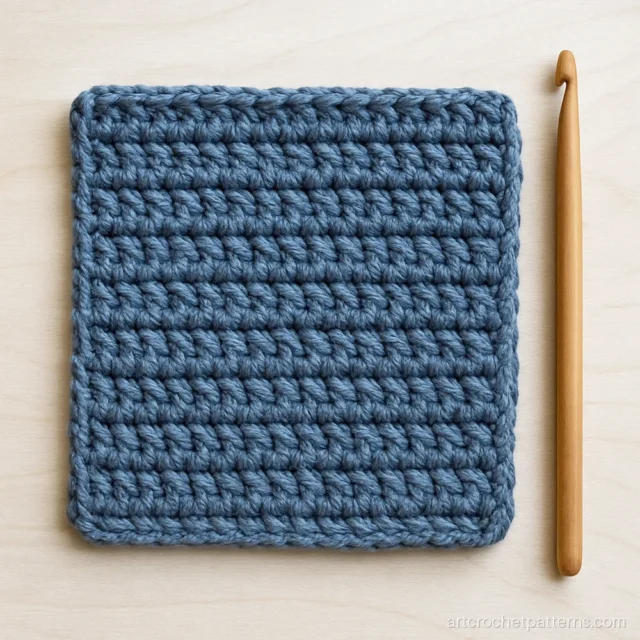 LevelEasyYarnWorsted cottonHook6 mm (J-10)
Thermal swatch in denim blue
Twelve rows of thermal stitch in worsted cotton. The ridges sit close together and there is no light showing through.
Maker note: Hold the swatch up to a window. If you see gaps, you missed the lower loop.
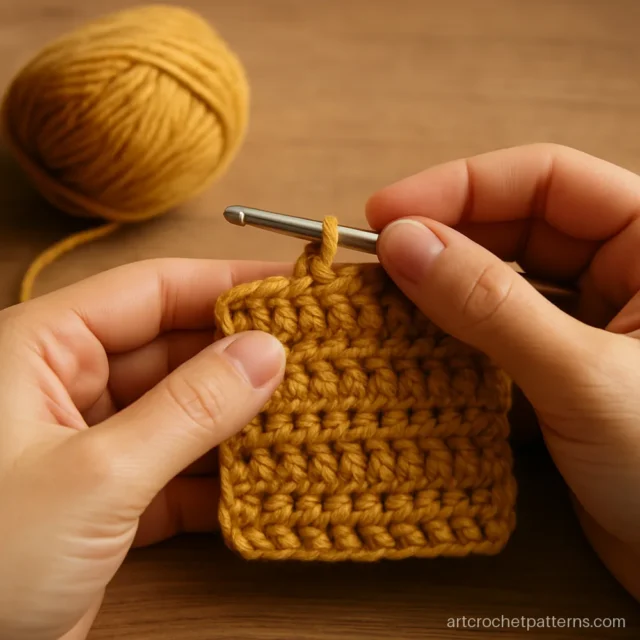 LevelEasyYarnWorsted acrylicHook6 mm (J-10)
Hook through two loops
First the back loop of the newest row, then the spare loop under it: both ride on the hook. Both loops sit on the hook together.
Maker note: Tilt the work toward you so the lower loop is easy to see before you insert the hook.
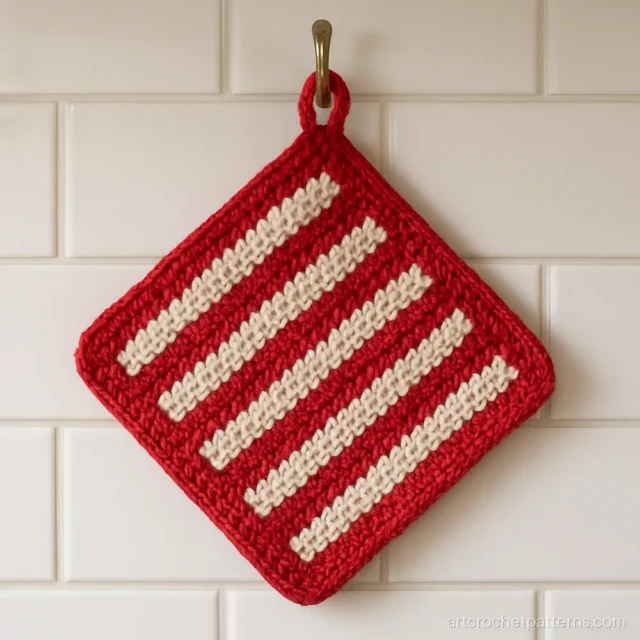 LevelEasyYarnWorsted cottonHook5.5 mm (I-9)
Red and white thermal potholder
Cotton thermal stitch is thick enough for a potholder in one layer. A hanging loop at one corner finishes it.
Maker note: Pure cotton only here; acrylic softens and may scorch near a hot pan.
Hook and yarn for thermal crochet
| Thermal yarn | Hook range | Use it for |
|---|---|---|
| Worsted cotton | 5.5 to 6 mm | Heat resistant potholders, trivets |
| Worsted wool | 6 mm | Windproof ear warmers and mitts |
| DK acrylic | 5 mm | Firm coasters, phone sleeves |
| Bulky | 8 mm | Very stiff bag bases and baskets |
Thermal fabric wants a roomier hook than the ball band lists, often by a full millimeter. Thermal stitch is so dense that the normal hook makes fabric too stiff to bend and slow to work. Pick a yarn that does not split, since the hook passes through two loops on every stitch.
Thermal stitch problems and repairs
| Trouble | Behind it | What helps |
|---|---|---|
| Hook jams in the double insertion | Snug tension, small hook | Size up and lift each loop tall |
| Holes between rows | Only one loop picked up | Count two strands on the shaft each time, then wrap |
| Fabric slants | Final stitch skipped | Clip a marker into each row end |
| Edges get thinner | Opening stitch missed after ch 1 | Put sc number one right beside the ch 1, in the end stitch |
| Fabric feels like cardboard | Undersized hook | Try 1 mm larger |
Thermal crochet stitch versus other dense stitches
Plain sc is solid but has tiny holes and some stretch. The linen stitch is flatter and drapes more, with a woven look. Waffle stitch is thick too, but it is made with post stitches and is squishy, not firm.
Thermal stitch beats all of them for blocking heat and wind. It also uses more yarn: plan on about one and a half times what the same size piece would take in plain sc.
Projects for the crochet thermal stitch
- A single layer crochet potholder in cotton.
- An ear warmer in wool that stops cold wind.
- Mitten cuffs and palms, where you want durability.
- Coasters and trivets that stay put on a table.
- The base of a bag or basket that should not sag.
Stripes are easy: the fresh color joins on the closing yarn over of that row's last stitch. The two loop structure carries the color neatly into the next row, and the stripe looks crisp on both sides.
Tips for working thermal stitch faster
Keep the work folded slightly toward you so the lower row tilts up and its free loop is easy to spot. Count your stitches at the end of the first three rows, then trust the rhythm. Use a hook with a pointy, inline head, which slides through two loops more easily than a rounded head. Take breaks: the tight insertion can tire your wrist.
Questions makers ask
How does the thermal stitch work?
Think of it as an sc that pierces two loops: the back loop of the last row and the spare loop one row lower. This joins rows together and makes thick, double layer fabric.
Is the crochet thermal stitch good for potholders?
Yes. In cotton, one layer of thermal stitch is thick enough for most kitchen use. Always use cotton, not acrylic, near heat.
How much extra yarn does thermal stitch eat?
It uses about one and a half times as much as plain single crochet for the same size, because each row is short and dense.
Can you work thermal crochet stitch in the round?
Yes, but the method changes, since you do not turn. You pair the back loop of the newest round with the spare loop two rounds down. Practice it flat first.
Why is my thermal stitch so hard to work?
The hook goes through two loops that sit close together. A bigger, pointy hook and a smooth yarn make it far easier.