
Linen stitch crochet alternates a single crochet with a chain 1 space, and on each new row the single crochets drop into the spaces below. The result looks like a tiny woven grid, lies very flat, and barely curls, which is why so many makers use it for scarves, bags and blankets.
In crochet, the names linen stitch, moss stitch, woven stitch and granite stitch usually describe this same fabric. This guide focuses on the look that gives the stitch its linen name: a firm, close weave worked in stripes of several colors, so the fabric reads like tweed cloth.
At a glance
Skill level
BeginnerStitches used
Ch, scFoundation
Even number of chainsYarn
Smooth DK or worstedHook
One size below the labelAlso called
Moss, woven or granite stitch
How to work linen stitch crochet
- Chain an even number. For practice, ch 22.
- Set up the grid. Skip the first chain and sc in the next, then ch 1, skip a chain, sc in the next. Repeat to the end. You see sc posts with little gaps between them.
- Turn and fill the gaps. On each new row, the sc goes into the chain 1 spaces of the row before, and the ch 1 sits on top of each old sc.
- Keep the edges straight. Rows alternate between two edge treatments, shown in the swatch below, so the sides stay square.
- Look at the fabric. After 6 rows you should see staggered sc, like bricks, with tiny holes that close up as the rows stack.
UK readers: every sc here is your dc. Insert the hook under the chain space, not into the chain itself; it is faster and the weave looks smoother.
Practice swatch with counts
- Ch 22.
- Row 1: Sc in 2nd ch from hook. *Ch 1, sk next ch, sc in next ch; rep from * across. (11 sc, 10 ch-1 sps)
- Row 2: Ch 1 (does not count), turn. Sc in first st, sc in next ch-1 sp. *Ch 1, sk next sc, sc in next ch-1 sp; rep from * to last st. Sc in last st. (12 sc, 9 ch-1 sps)
- Row 3: Ch 1, turn. Sc in first st. *Ch 1, sk next sc, sc in next ch-1 sp; rep from * to last 2 sts. Ch 1, sk next sc, sc in last st. (11 sc, 10 ch-1 sps)
- Rows 4 to 21: Rep Rows 2 and 3 nine more times. (Even rows 12 sc and 9 sps, odd rows 11 sc and 10 sps)
- Fasten off.
Count only the single crochets on each row. The two row types swap between 11 and 12, which keeps both side edges straight.
In pictures
What the work should look like, with the yarn and hook used for each sample.
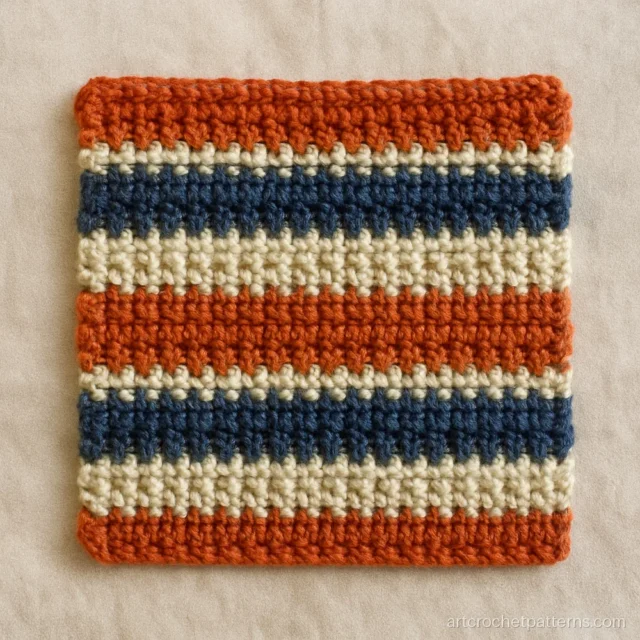 LevelBeginnerYarnDK woolHook3.5 mm (E-4)
Three color tweed swatch
Changing color every two rows breaks up the stripes into a speckled weave that looks like cloth.
Maker note: Work two rows per color so the idle shades ride along the edge and you skip a pile of cut ends.
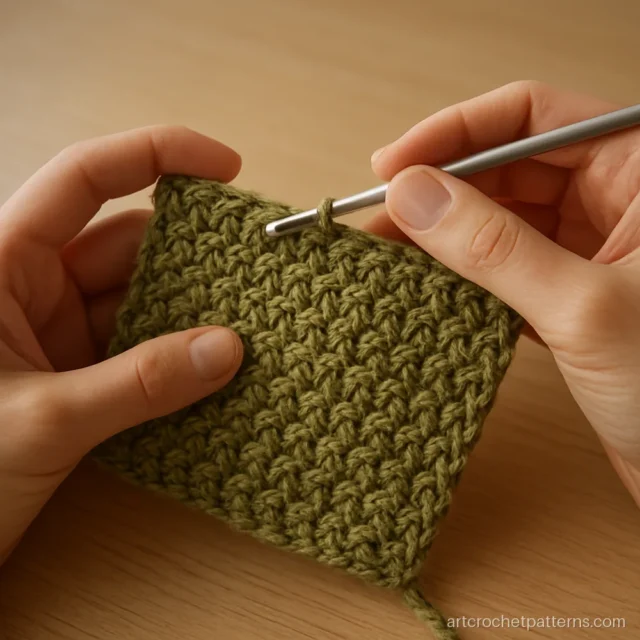 LevelBeginnerYarnWorsted cottonHook4.5 mm (7)
Working into a chain space
The hook goes under the chain 1 of the row below, never into the top of a single crochet.
Maker note: Go under the whole chain, not into it; the fabric looks neater and you work faster.
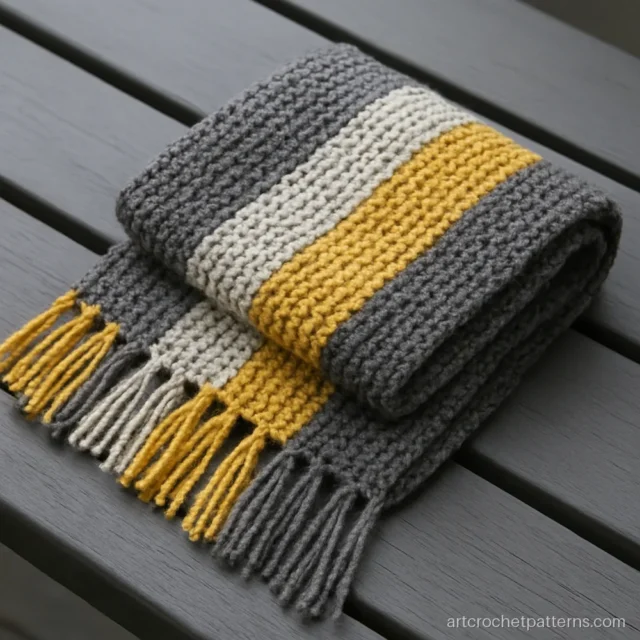 LevelEasyYarnFingering wool blendHook3.25 mm (D-3)
Lengthwise striped scarf
Worked along the long edge, every stripe travels end to end along the scarf with tassels made from the tails.
Maker note: Cut the yarn at every row change, leaving long ends, and knot those ends into fringe.
Striping for a woven tweed look
The linen look comes alive with color. Because each sc sits between two sc of a different row, stripes break into flecks instead of solid bands.
- Two rows per color: the yarn ends at the same edge where it began, so you can float the waiting colors along the edge. Easiest option.
- One row per color: the most woven look, but each color ends at the far edge. Use 3 or more colors so a waiting color is always on your side, or cut and leave tails for fringe.
- Lengthwise rows: chain the full length of a scarf and stripe across it. Long stripes look like woven cloth.
Pick colors with clear contrast in lightness, such as a dark, a medium and a light. For the color change itself, see changing colors in crochet.
Choosing hook and yarn for crochet linen stitch
| Yarn | Hook | Fabric |
|---|---|---|
| Fingering wool | D-3 (3.25 mm), or 3 mm | Fine, drapey scarves and wraps |
| DK wool or blend | 3.5 mm | Tweed like scarves, hats, cowls |
| Worsted cotton | 4.5 mm | Sturdy bags, placemats, coasters |
| Worsted acrylic | 5 mm | Soft, washable blankets |
Linen stitch looks best a little firm, so many makers pick a hook one step smaller than the ball band shows. Smooth, solid or lightly heathered yarns show the grid. Fuzzy mohair hides it.
Uneven rows and how to sort them out
| Sign | Cause | What to change |
|---|---|---|
| Swatch gets narrower | Skipped the last sc on odd rows | Always end with sc in the last st |
| Swatch gets wider | Worked an sc into the top of an sc | Every sc goes into a ch-1 space, except the edge sts |
| Fabric looks lacy | Hook too large or chains loose | Drop one hook size and tighten the ch 1 |
| Starting chain puckers | Foundation chain tight | Chain on a larger hook, then switch back |
Projects for linen stitch
The flat, non curling fabric makes this stitch a good choice for a crochet scarf, placemats, a laptop sleeve or a tote bag. In worsted acrylic it makes a light blanket with good drape. Compare it with the moss stitch guide, and find more flat textures in the stitch library.
Questions makers ask
Is linen stitch the same as moss stitch in crochet?
Usually yes. Both alternate sc and ch 1 and place each sc in the space below. Some designers use linen stitch to mean a tighter, multicolor version of the same fabric.
What happens if my chain count is odd?
With an even chain, both ends of Row 1 land on a sc, with every gap the same size. An odd chain leaves the last stitch in the wrong place.
Is linen stitch hungry for yarn?
Yardage runs close to plain sc, sometimes a little less because of the chain spaces. It is a thin fabric, so it is good for scarves that will not feel bulky.
Does crochet linen stitch curl?
Very little. Those little chain gaps relax the pull of each row, so the piece stays flat, which is one reason it is popular for scarves and placemats.
Can I work linen stitch in the round?
Yes. Keep the round count even, close each lap with a sl st and flip the work, or work in a continuous spiral putting each sc into the next chain space.