
Block stitch crochet is a simple checkerboard: a block of three double crochet, then a gap of three chains, with the blocks and gaps trading places every row. The result looks like little bricks set in a grid of windows.
You only need chains and double crochet. There is no counting into single stitches after the first row, because every new block goes into a chain space. That makes the crochet block stitch quick and relaxing once it is set up.
The name can confuse people. Blocking is a finishing step where you wet and shape a piece, and it has nothing to do with this stitch. A short section near the end explains how to block crochet so you can do both.
At a glance
Skill level
EasyStitches used
ch, dcMultiple
6 chains plus 5Yarn
Worsted cotton or acrylicHook
5 mm (H-8)Good for
Market bags, shawls, light throwsUK term
Blocks of 3 treble (UK)
How to crochet the block stitch, step by step
Chain a multiple of 6 plus 5. The swatch below uses 29 chains, which gives five blocks.
- First block: work a dc into chain number 4 counting from the hook, then one more dc in the chain after it. The three skipped chains count as one dc, so you now have a block of three stitches.
- First window: chain 3, then skip the next 3 chains of the foundation. The new chain should lie flat across the skipped ones.
- Next block: dc in each of the next 3 chains. Repeat the window and block to the end. You should finish with a block.
- Turn and shift: on the next row, chain 6. This counts as a dc plus a ch 3 window and sits over the first block.
- Fill the windows: work 3 dc into the next ch 3 space, chain 3, and keep going. Blocks now sit over windows and windows over blocks.
- Finish the shifted row: after the last block, chain 3 and dc in the top of the turning chain.
Each new block should sit in the center of the window below, like bricks in a wall.
Block stitch crochet swatch pattern
For this swatch, worsted and a 5 mm hook give the clearest grid. Turning chains count as stitches in this swatch.
- Ch 29.
- Row 1: dc in 4th ch from hook and in next ch, *ch 3, sk 3 ch, dc in next 3 ch; rep from * across. Turn. (5 blocks, 4 ch-3 sps)
- Row 2: ch 6 (counts as dc and ch 3), sk next 2 dc, 3 dc in next ch-3 sp, *ch 3, 3 dc in next ch-3 sp; rep from * across, ch 3, dc in top of turning ch. Turn. (4 blocks, 5 ch-3 sps, 2 edge dc)
- Row 3: ch 3 (counts as dc), 2 dc in first ch-3 sp, *ch 3, 3 dc in next ch-3 sp; rep from * to turning ch sp, ch 3, 2 dc in turning ch sp, dc in 3rd ch of turning ch. Turn. (5 blocks, 4 ch-3 sps)
- Rows 4 to 9: rep Rows 2 and 3 three more times.
- Fasten off.
The swatch measures about 8 inches wide and 5 inches tall in worsted. To make it wider, add 6 chains per extra block.
In pictures
What the work should look like, with the yarn and hook used for each sample.
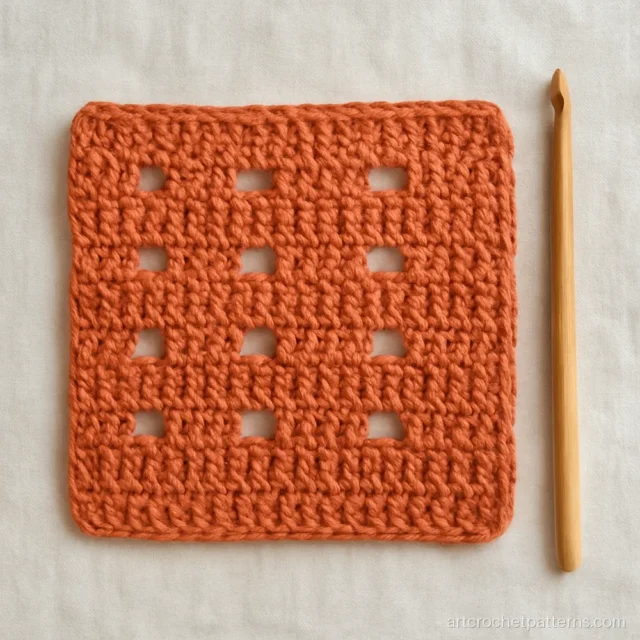 LevelEasyYarnWorsted cottonHook5 mm (H-8)
Block stitch swatch in terracotta
Five rows of the stitch in worsted cotton. The open squares are the same size as the solid ones, which gives the clean grid.
Maker note: Keep the ch 3 relaxed. A tight chain makes the windows smaller than the blocks.
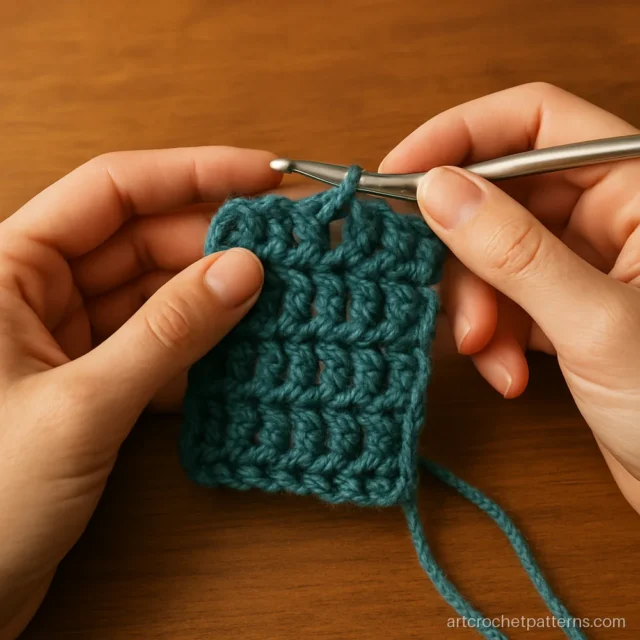 LevelEasyYarnWorsted acrylicHook5 mm (H-8)
Working a block into a chain space
The hook goes under the whole chain loop, not into a single chain. That is why the stitch moves so fast.
Maker note: Push each new dc to the left side of the space so the three fit side by side.
 LevelEasyYarnWorsted cottonHook5 mm (H-8)
Block stitch market bag
The open squares stretch around fruit and bread but still hold shape. Natural cotton keeps the look simple.
Maker note: Work the bag in turned rounds so the checkerboard stays aligned all the way up.
Choosing yarn for the crochet block stitch
| Yarn weight | Hook | Result |
|---|---|---|
| Fingering | 3.25 mm | Fine, lacy grid for a light shawl |
| DK | 4.5 mm | Soft summer top or wrap |
| Worsted cotton | 5 mm | Firm grid for bags and placemats |
| Bulky | 8 mm | Quick throw with big windows |
A smooth yarn shows the grid best. Fuzzy mohair or chenille fills in the windows and hides the pattern. Cotton is the top pick for a crochet market bag because it does not sag under weight.
Block stitch slip ups
| What you notice | Reason | Remedy |
|---|---|---|
| Edges lean in | The edge dc on shifted rows was missed | End every shifted row with ch 3 and a dc in the turning chain |
| Blocks stack instead of alternating | Dc were worked into the dc below | Aim every new block at a ch 3 gap, not at dc tops |
| Windows look squashed | Chains are tighter than the dc | Chain loosely or chain 4 instead of 3 |
| Rows have uneven numbers of blocks | A space was skipped near the edge | Count blocks: rows alternate 5 and 4 plus edges |
Block stitch versus filet and granny stitches
Filet crochet also uses blocks and spaces, but its blocks are 2 or 3 dc over a mesh of single dc posts, and you draw pictures with them from a chart. The filet crochet patterns page covers that style.
The granny stitch puts 3 dc groups into the spaces between groups with no chains or a single chain between them. It looks dense. Block stitch, with its full ch 3 windows, is much more open and uses less yarn.
Some patterns call a solid square in filet a block too, so read the stitch key before you start.
How to block crochet after you finish
Blocking evens out the grid and makes every window square. It is a separate step from the stitch itself.
- Give the grid a 15 minute bath: cool water, a spoonful of wool wash, no rubbing.
- Press out water in a towel. Do not wring.
- Lay it flat on foam mats and pin the corners, then pin along each edge every 2 inches.
- Let it dry fully before unpinning.
Acrylic does not hold a wet block well; steam it lightly from above instead, without touching the iron to the yarn. The blocking crochet guide covers each fiber in detail.
Projects that suit block stitch
Try a long rectangle for a summer scarf, or a big square in DK for a beach cover up. In cotton, the stitch makes great placemats that wash well. A plain sc border around the edge squares up the uneven ends from the turning chains. See the crochet borders page for ideas, or see more grid textures on the crochet stitches hub.
Questions makers ask
What is the block stitch in crochet?
It is a stitch pattern of 3 dc blocks separated by ch 3 spaces. On each new row, blocks are worked into the spaces so the solid and open squares alternate like a checkerboard.
Is block stitch the same as blocking?
No. Block stitch is a texture you crochet. Blocking is a finishing step where you wet or steam a finished piece and pin it to shape.
What multiple do I chain for block stitch?
Chain a multiple of 6 plus 5. Each extra block and window adds 6 chains. 29 chains give five blocks on the first row.
Is the crochet block stitch warm enough for a blanket?
It is open, so it suits a light summer throw more than a winter blanket. For warmth, use bulky wool or line the throw with fleece.
Does the turning chain count in block stitch?
Yes. Ch 3 counts as the first dc of a block, and ch 6 counts as a dc plus a ch 3 space. The final dc of each row lands in the top of the turning chain.