
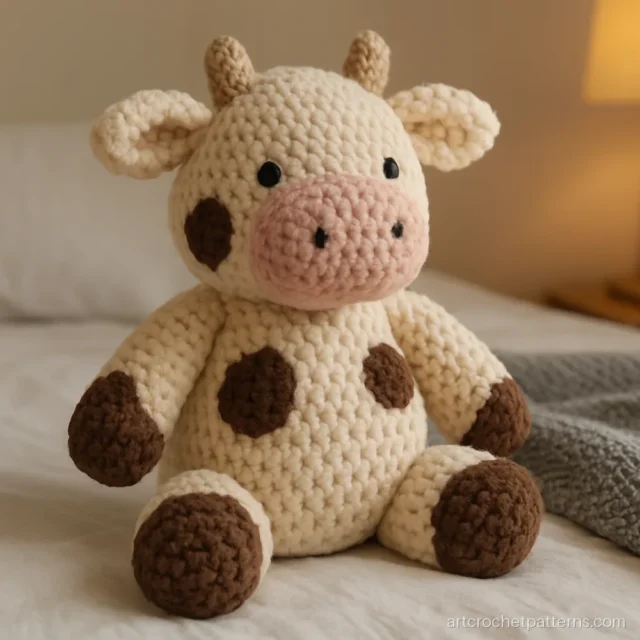
A crochet cow is one of the friendliest toys you can make, and this page has a complete free pattern for a sitting cow about 6 inches tall plus six cow crochet ideas to try after it. The classic look is simple: a white body, a pink oval muzzle, black spots and two little horns.
Most of the cow is single crochet in spiral rounds. The spots are flat circles sewn on, so you never have to change colors mid round. New to toys? Read the core method on the amigurumi hub first.
At a glance
Skill level
Easy (beginner with one toy made)Yarn
Worsted acrylic or cotton: white, pink, black, tanHook
3.5 mm (E-4)Size
About 6 inches tall sittingTime
4 to 6 hoursStitches used
MR, sc, inc, dec, BLO sc, sl st
6 crochet cow designs to make
Every design lists the skill level, yarn and hook, with a note from the maker.
 LevelEasyYarnWorsted acrylicHook3.5 mm (E-4)
Classic sitting cow
The cow from the pattern below: white body, sewn black spots, a rounded pink muzzle and tan horns. Sturdy enough for play once the eyes are embroidered.
Maker note: Place spots over seams where legs join; they hide uneven sewing nicely.
 LevelEasyYarnWorsted cottonHook3.5 mm (E-4)
Brown calf with long lashes
Fawn brown all over with a cream muzzle. Embroidered closed eyes with three lashes give a sleepy, gentle look.
Maker note: Use a single strand of floss for lashes; full yarn looks heavy at this size.
 LevelIntermediateYarnWorsted wool blendHook4 mm (G-6)
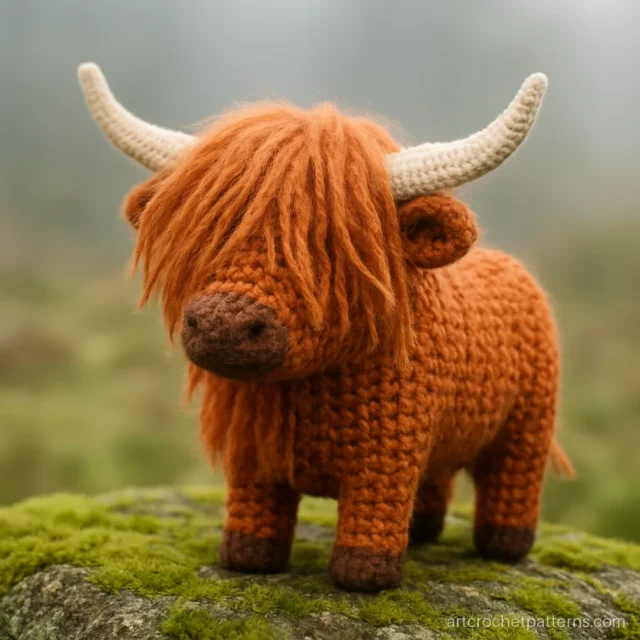
Shaggy highland style cow
Loops of brushed yarn hide the eyes and wide horns curve out to the sides. The highland pattern page covers the fringe method.
Maker note: Brush the fringe with a pet slicker brush after attaching it for a fluffy coat.
 LevelEasyYarnFingering cottonHook2.25 mm (B-1)
Pocket mini cow
The head pattern alone, worked in fingering cotton, makes a 2 inch keychain. Ears and horns are sewn on with a single strand.
Maker note: Anchor the metal ring with yarn passed through four or five rounds of the head, not just one.
 LevelIntermediateYarnWorsted cottonHook4.5 mm (7)
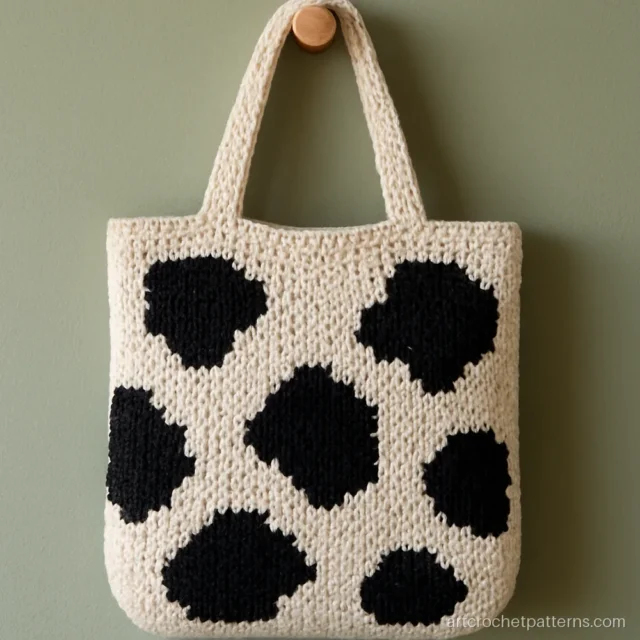
Cow print tote
Not a toy at all: black patches worked into a white tote with tapestry crochet. A playful cow crochet idea for adults.
Maker note: Sketch blobs on graph paper first; uneven organic shapes look more like real cow hide.
 LevelEasyYarnBulky chenilleHook6 mm (J-10)
Cuddle size chenille cow
Follow the same rounds in bulky chenille with a 6 mm hook and the cow grows to about 13 inches. Embroidered eyes suit any age.
Maker note: Chenille stretches; stuff firmly but push filling in slowly so the stitches do not open up.
Free crochet cow pattern: the sitting cow
Make the head and body separately, then the small parts. Stuff each piece before sewing, and save sewing the spots for last so you can place them where they look best.
Materials: worsted acrylic or cotton in white (about 70 yards), pink (15 yards), black (15 yards) and tan (5 yards); 3.5 mm (E-4) hook; fiberfill; stitch marker; tapestry needle; black yarn for eyes, or 10 mm safety eyes for older kids. Work in a spiral without joining unless told.
Head (white)
- Rnd 1: 6 sc in MR (6).
- Rnd 2: inc in each st (12).
- Rnd 3: (sc, inc) x6 (18).
- Rnd 4: (2 sc, inc) x6 (24).
- Rnd 5: (3 sc, inc) x6 (30).
- Rnds 6 to 11: sc in each st (30).
- Eyes go between Rnds 8 and 9, 6 sts apart.
- Rnd 12: (3 sc, dec) x6 (24).
- Rnd 13: (2 sc, dec) x6 (18). Stuff firmly.
- Rnd 14: (sc, dec) x6 (12).
- Rnd 15: dec x6 (6). Fasten off and close.
Muzzle (pink)
- Ch 6. Rnd 1: sc in 2nd ch from hook, sc in next 3 ch, 3 sc in last ch; on the other side of the chain, sc in next 3 ch, 2 sc in last ch (12).
- Rnd 2: inc, sc in next 3, inc in next 3, sc in next 3, inc in next 2 (18).
- Rnds 3 and 4: sc in each st (18). Fasten off, leaving a long tail.
Body (white)
- Rnds 1 to 5: as head Rnds 1 to 5 (30).
- Rnds 6 to 10: sc in each st (30).
- Rnd 11: (3 sc, dec) x6 (24).
- Rnd 12: sc in each st (24).
- Rnd 13: (2 sc, dec) x6 (18).
- Rnd 14: sc in each st (18). Fasten off with a long tail. Stuff firmly.
Legs (make 4)
- With black, Rnd 1: 6 sc in MR (6).
- Rnd 2: inc in each st (12).
- Rnd 3: in back loops only, sc in each st (12).
- Rnd 4: sc in each st (12). Change to white.
- Rnds 5 to 8: sc in each st (12). Stuff and fasten off with a tail.
Ears (white, make 2)
- Rnd 1: 6 sc in MR (6).
- Rnd 2: (sc, inc) x3 (9).
- Rnd 3: (2 sc, inc) x3 (12).
- Rnd 4: sc in each st (12).
- Rnd 5: (2 sc, dec) x3 (9).
- Rnd 6: (sc, dec) x3 (6). Flatten, do not stuff.
Horns (tan, make 2)
- Rnd 1: 4 sc in MR (4).
- Rnd 2: (sc, inc) x2 (6).
- Rnds 3 and 4: sc in each st (6). Stuff lightly.
Spots (black, make 3 to 5)
- Rnd 1: 6 sc in MR (6).
- Rnd 2: inc in each st (12).
- Rnd 3 (optional, for a lopsided spot): (sc, inc) x3, sc in next 6 (15). Sl st and fasten off.
Tail: with white, ch 12, sl st in 2nd ch from hook and in each ch back (11). Knot three short black strands through the tip and trim to 1 inch.
Putting the cow together
- Muzzle first. Pin it across Rnds 9 to 14 of the head, below the eyes, and sew it on with a little stuffing tucked behind. Stitch two black nostrils with straight stitches.
- Head to body. Press the unclosed top of the body against the bottom of the head, a touch toward the back. Sew around twice for a firm neck that will not wobble.
- Back legs attach near the base on either flank, toes forward, so the cow sits. Front legs attach just under the head.
- Ears sit at the sides at eye level, folded at the base. Horns go on top between Rnds 4 and 5, about 8 sts apart.
- Spots last. Pin several and step back before you sew. One spot over an eye and another across the back look classic.
Picking yarn so your cow comes out the right size
| Yarn | Hook | Finished cow |
|---|---|---|
| Fingering cotton | B-1 | About 2 1/2 inches, keychain size |
| DK acrylic | C-2 to D-3 | About 4 1/2 inches, shelf toy |
| Worsted acrylic or cotton | E-4 | About 6 inches, the pattern size |
| Bulky chenille | J-10 | About 13 inches, a cuddle toy |
White yarn shows dirt, so choose an acrylic or cotton that can go through a gentle wash. Bright pure white also shows stuffing more than cream does; a tight hook matters even more here.
Highland cows and other variations
For a shaggy crochet highland cow, work the body in rust or cream and add rows of fringe or loop stitch over the head and back. Horns get longer and curve outward. The highland cow crochet pattern page walks through the fringe in detail. Other ideas: a brown calf with no horns, a black and white dairy cow lying down (skip the legs and sew four short stubs underneath), or a cow print tote using tapestry crochet. Pair your cow with a pig and a chicken for a farm set.
Cow troubles and fixes
| Issue | Root of it | Fix it like this |
|---|---|---|
| Head droops forward | Neck sewn with one pass | Sew around the neck twice and add stuffing into the join |
| Muzzle looks flat | No filling behind it | Push a small tuft inside before closing the last inch |
| Spots curl up | Spot crocheted too tightly | Steam the spots flat before sewing, or rework them on a slightly larger hook |
| Cow will not sit | Back legs too far back | Move them forward to the lower sides |
| Black shows through white | Color change carried loosely | Switch colors while finishing the stitch before, then tug the new strand tight |
Questions makers ask
Can a new crocheter manage this cow crochet pattern?
It makes a fine second or third toy. Every piece is basic rounds of sc. The new skills are the oval muzzle, worked around a chain, and placing many small parts.
How many yards of yarn go into one crochet cow?
About 70 yards of white plus small amounts of pink, black and tan in worsted weight. One standard ball of white is plenty for two cows.
How do I crochet the cow spots?
Make flat circles of 6 and 12 stitches, with an optional lopsided third round, and sew them on. Real cow patches are irregular, so mix sizes and let a few wrap around a leg.
Can I make the cow safe for a baby?
Use embroidered eyes, leave off the tail strands, and sew horns and ears on very firmly. Check every part with a strong tug before giving it.
How do I make a lying down cow instead?
Work the body longer, about 10 straight rounds, and sew it horizontally under the head. Add four short stubs of 6 sts underneath for legs.
What is the difference between this and a highland cow?
A highland cow has long shaggy hair, usually in rust or ginger, and wide curved horns. The base shapes are similar, but most of the work goes into the fringe.