
A crochet head scarf is a small triangle that ties at the nape of the neck, and the kerchief pattern here takes about one ball of DK cotton and a few relaxed evenings. It is a granny triangle: clusters of three double crochet that grow outward from a tiny ring, with a single crochet band and ties added at the end.
Head scarves keep hair out of your eyes in the garden, cover a bad hair day and add color to a plain outfit. Rows let you quit at whatever size the wearer needs. Fewer rows make a kerchief for a seven year old; more rows give a deeper scarf that covers the back of an adult head.
At a glance
Skill level
Beginner to easyYarn
DK (3) cotton, 150 to 180 yardsHook
4 mm (G-6)Time
4 to 6 hoursStitches used
ch, sl st, dc, scSize
About 23 inch top edge, 11 inches deep, plus ties
6 crochet head scarf designs to make
Every design lists the skill level, yarn and hook, with a note from the maker.
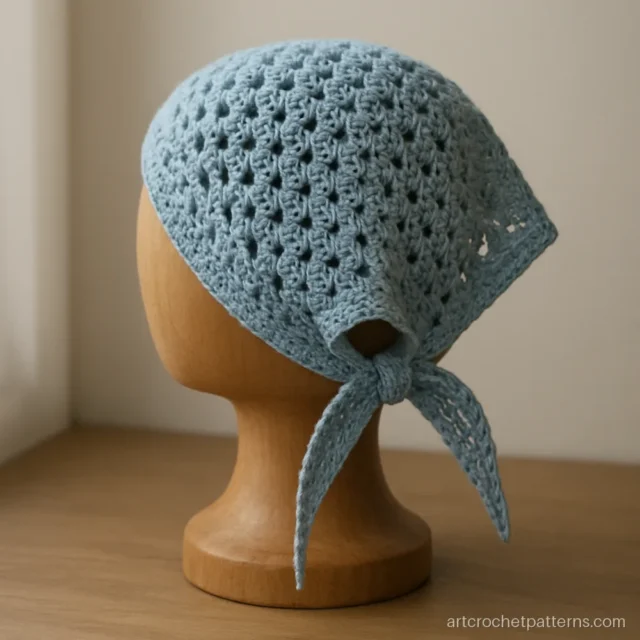 LevelBeginnerYarnDK (3) cottonHook4 mm (G-6)
Sky blue granny kerchief
The pattern below in one calm color. The open clusters let air through on hot days.
Maker note: Tally the clusters as each row finishes. Each new row should have two more than the last.
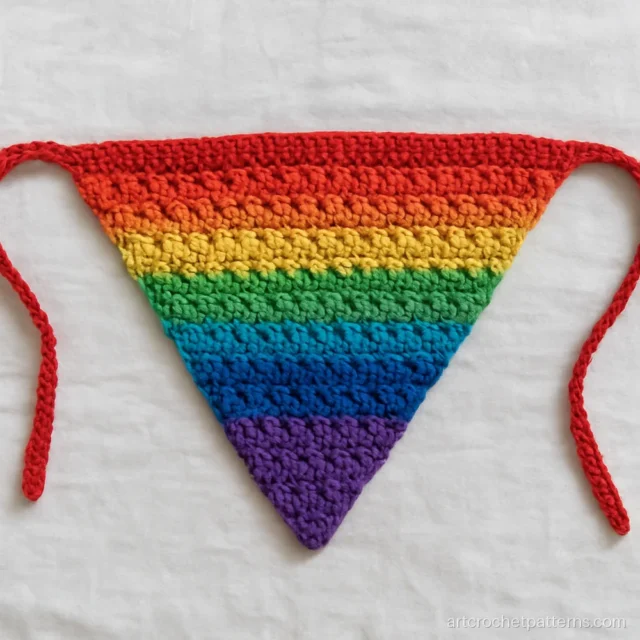 LevelEasyYarnDK (3) cottonHook4 mm (G-6)
Rainbow striped granny triangle
Change color every row for a cheerful stripe. Carry nothing; fasten off and rejoin at the edge each time.
Maker note: So many ends add up fast. Crochet over the tails as you work the next row to save sewing later.
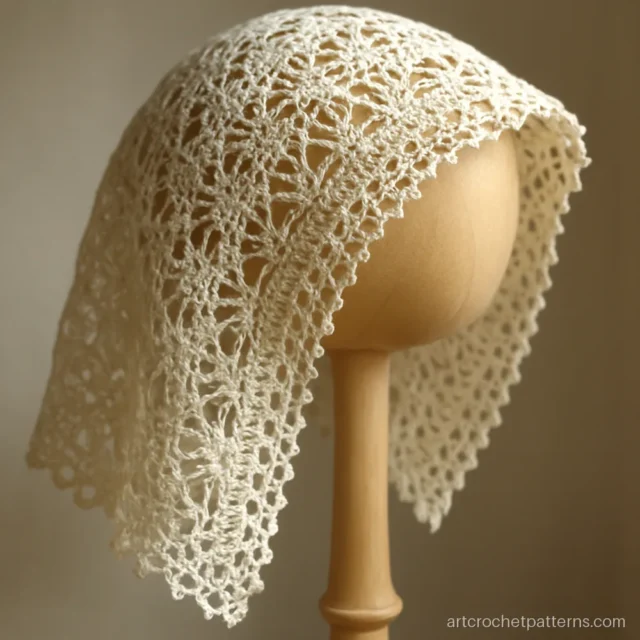 LevelIntermediateYarnFingering (1) shiny cottonHook2.75 mm (C-2)
Ivory lace fan bandeau
Fan stitch rows and a picot edge make a dressy scarf for a garden wedding. Mercerized cotton gives a soft sheen.
Maker note: Block lace on a foam mat with rust proof pins so the fans open and the points stay sharp.
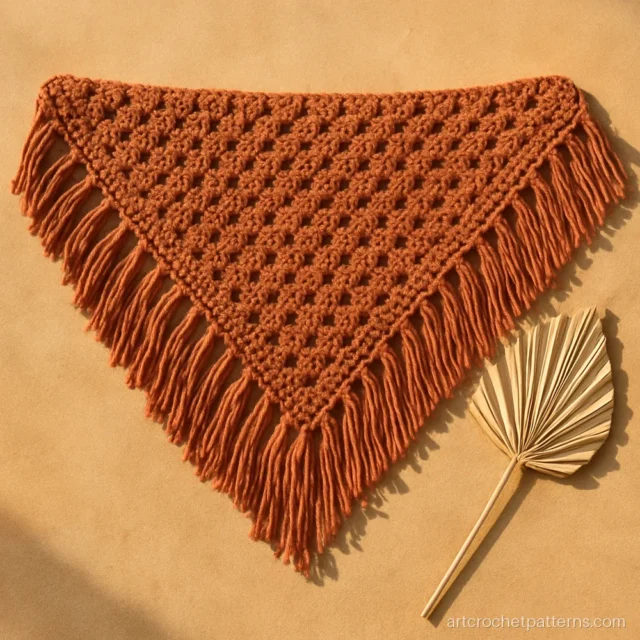 LevelEasyYarnDK (3) cotton linenHook4 mm (G-6)
Terracotta fringe head scarf
A fringe on the slanted edges swings as you move. Use the same yarn so the fringe matches the body exactly.
Maker note: Cut fringe on a book or a piece of card so the strands come out even before knotting.
 LevelEasyYarnSport (2) bamboo blendHook3.5 mm (E-4)
Black mesh hair kerchief
Simple chain mesh in fine yarn sits light on the hair. The scalloped border hides the row ends.
Maker note: Mesh stretches lengthwise. Measure the ties after a gentle tug, not before.
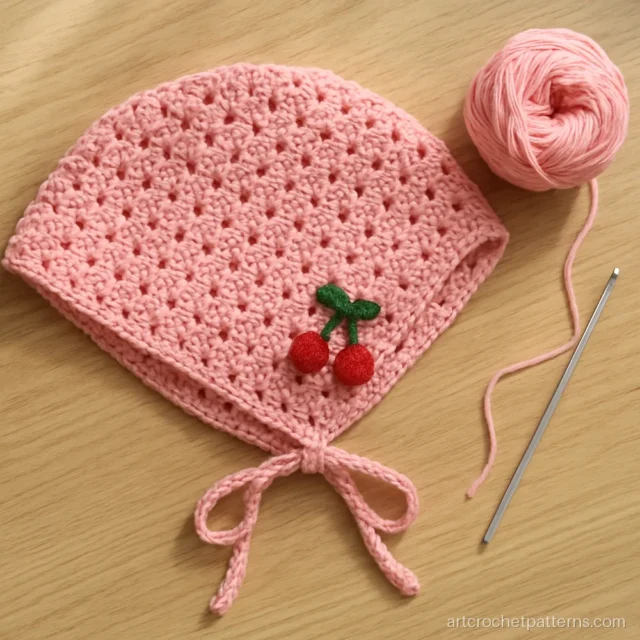 LevelEasyYarnDK (3) cottonHook4 mm (G-6)
Small cherry kerchief
Stop at row 11 for a kerchief that fits most kids. Tiny cherries sewn near the point make it a favorite.
Maker note: Sew the cherries on tightly with doubled yarn and knot inside so little fingers cannot pull them off.
Granny triangle crochet head scarf pattern
You work this in rows from the center of the top edge outward, so the first ring sits in the middle of the long side and the point grows toward the back of the neck. Turn the kerchief after each row. Count each starting ch 3 as a dc of the edge cluster.
Supplies
- DK (3) cotton, 150 to 180 yards
- Hook: G-6 (4 mm)
- Tapestry needle and a marker for the point
Gauge
Gauge is loose for a kerchief. Four rows measure about 2.75 inches along the top edge on each side of the ring. Sixteen rows gives a 23 inch top edge and an 11 inch depth.
- Ch 4 and sl st to the first ch to make a ring.
- Row 1: ch 3, 2 dc in the ring, ch 2, 3 dc in the ring. Turn. (2 clusters, 1 ch-2 point)
- Row 2: ch 3, 2 dc in the first st, ch 1, (3 dc, ch 2, 3 dc) in the ch-2 point, ch 1, 3 dc in the top of the turning ch. Turn. (4 clusters)
- Row 3: ch 3, 2 dc in the first st, ch 1, 3 dc in the next ch-1 sp, ch 1, (3 dc, ch 2, 3 dc) in the point, ch 1, 3 dc in the next ch-1 sp, ch 1, 3 dc in the top of the turning ch. Turn. (6 clusters)
- Row 4 and on: ch 3, 2 dc in the first st, ch 1, 3 dc in each ch-1 sp with ch 1 between, (3 dc, ch 2, 3 dc) in the point, then 3 dc in each ch-1 sp with ch 1 between, ch 1, 3 dc in the top of the turning ch. Turn. Each row adds 2 clusters, so Row 4 has 8.
- Stop after Row 16 for an adult (32 clusters) or Row 11 for a child (22 clusters). Do not fasten off.
Band and ties
The band runs along the long top edge, which is made of row ends.
- Ch 45. Sc in the 2nd ch from the hook and in each ch back to the scarf. (44)
- Working along the top edge, put 2 sc into the side of each row end, and 2 sc over the ring at the center. (66 sc on the adult size, 46 on the child size)
- Ch 45. Sc in the 2nd ch from the hook and in each ch back to the scarf. (44) Sl st into the last sc of the band and fasten off.
Each tie is about 9 inches long. Weave the ends into the band, where they will not show from the front.
Fitting the kerchief
A head scarf only needs to reach around the top of the head from ear to ear and leave enough tie to knot. Measure from the front of one ear, over the crown, to the front of the other ear. Add about 2 inches, and that is your top edge.
| Wearer | Ear to ear over the crown | Stop after | Tie chain |
|---|---|---|---|
| Child 3 to 7 years | 12 to 14 inches | Row 11 | ch 35 |
| Older child and teen | 14 to 16 inches | Row 13 or 14 | ch 40 |
| Adult | 16 to 18 inches | Row 16 | ch 45 |
| Adult with thick or long hair | 18 inches and up | Row 18 | ch 50 |
For full head and neck coverage in cold weather, a hood or a crochet balaclava does the job better than a kerchief.
Cotton, linen or bamboo for a scarf on the hair
Pick a smooth plant fiber that stays cool and does not cling. Wool and fuzzy acrylic catch on hair and feel warm in summer.
- Matte DK cotton on a 4 mm hook is the easy choice. It softens with each wash and shows clusters clearly.
- Cotton and linen blends drape more and have a gentle, slubby look. They crease less when knotted.
- Bamboo blends feel silky and slide well over smooth hair, but they grow a little when wet, so dry them flat.
- Mercerized fingering cotton on a C-2 hook makes fine, lacy scarves that look almost like fabric.
The cotton yarn guide covers how each cotton finish behaves on the hook.
Fixing a lopsided triangle
- One side is longer than the other. You missed the 3 dc in the turning chain on some rows. Count clusters every row; both halves should match.
- The point is rounded, not sharp. The corner needs ch 2, not ch 1. Mark the point with a clip so you always find it.
- The top edge curls. The band is too tight. Use 2 sc per row end and a hook one size larger for the band only.
- The ties twist like ribbons. Single crochet on a chain often spirals. Steam the ties flat, or work them as a crochet cord instead.
Ways to change the head scarf
Swap the ties for elastic and you have a stay on scarf for running. Sew a small button and loop at the nape instead of ties for a cleaner look. Add a crab stitch or picot edge on the two slanted sides. For a solid band that sits flat on the forehead, browse the crochet headband ideas; and for a triangle worn around the neck instead of on the head, try the crochet bandana. More hair and neck pieces sit in the accessories section.
Questions makers ask
How do you wear a crochet head scarf?
Lay the long edge across your head just behind the hairline, let the point fall toward the back, and tie the ends at the nape under the point. For a bandana look, tie the ends over the point instead so it stays tucked.
How much yarn does a crochet kerchief use?
The adult size in DK cotton takes 150 to 180 yards, about one standard ball. The child size uses around 90 yards. Fringe or a lace edge adds 30 to 50 yards.
Can I make a head scarf in a heavier yarn?
Yes. A 5 mm hook and worsted (4) cotton will do it, but each row is larger, so stop around Row 13 and measure. Heavier scarves feel warmer and suit spring and autumn more than summer.
Why does my granny triangle look like a fan instead of a triangle?
You are adding extra stitches at the point or at the edges. The point gets exactly the same corner group every row, and the two edges each take one 3 dc group, at the first stitch and in the turning chain. Nothing more.
How do I wash a cotton head scarf?
Follow the care on the yarn band. A cotton kerchief can usually ride through a gentle machine cycle zipped inside a small washing net. Dry it flat afterward so the ties keep their length.