
This fingerless gloves crochet pattern starts as a flat ribbed rectangle, gets folded in half and is stitched up the side with a gap left for your thumb. That is the whole trick, and it means a beginner can make a pair of crochet hand warmers without ever working a gusset.
After the rows come a hand size table, six design ideas from cabled wrist warmers to lacy cotton mitts, and help for the two places these gloves usually go wrong: a thumb hole that sits too high, and a cuff that slides down.
At a glance
Skill level
BeginnerYarn
Worsted (4) wool or wool blend, 120 to 160 yards per pairHook
5 mm (H-8)Time
3 to 4 hours for twoStitches used
ch, hdc in BLO, sc, whip stitchSize
Adult medium, 7 inches long
6 fingerless gloves designs to make
Every design lists the skill level, yarn and hook, with a note from the maker.
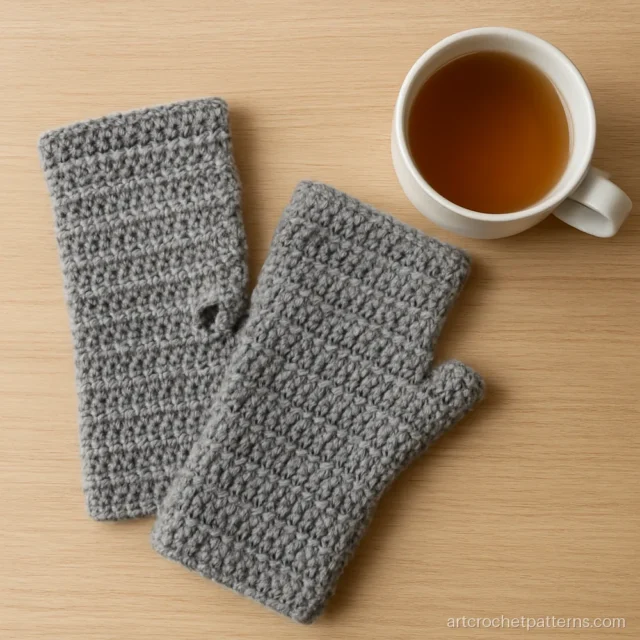 LevelBeginnerYarnWorsted (4) wool blendHook5 mm (H-8)
Ribbed grey hand warmers
Sideways ribs hug the palm and stretch over the knuckles. This pair follows the written rows further down.
Maker note: Try the rectangle around your hand before seaming. Remove two rows if it wraps loosely.
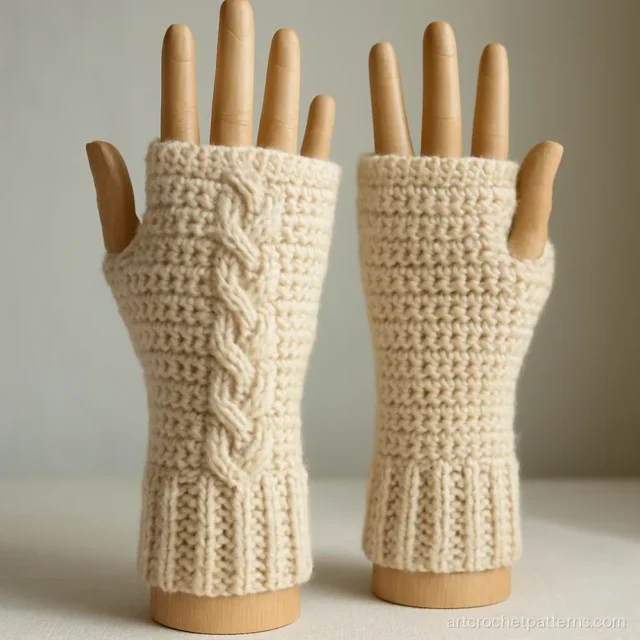 LevelIntermediateYarnWorsted (4) merinoHook5 mm (H-8)
Long cabled wrist warmers
A cable of crossed front post stitches climbs from the wrist to the knuckles. The longer cuff tucks into a coat sleeve.
Maker note: Work these in the round from the cuff up, so the cable is not broken by a seam.
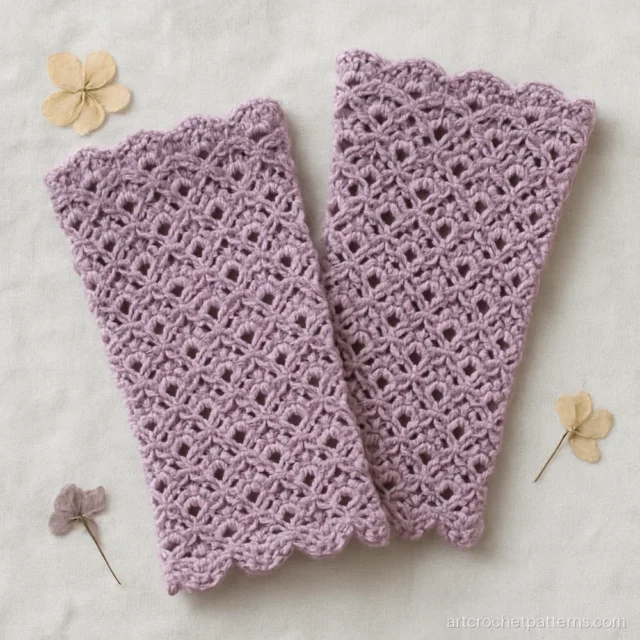 LevelIntermediateYarnFine (2) cottonHook3.5 mm (E-4)
Lacy cotton spring mitts
Open shells in fine cotton make light gloves for cool spring mornings or for a wedding outfit.
Maker note: Cotton does not stretch, so match the hand measurement exactly instead of making them smaller.
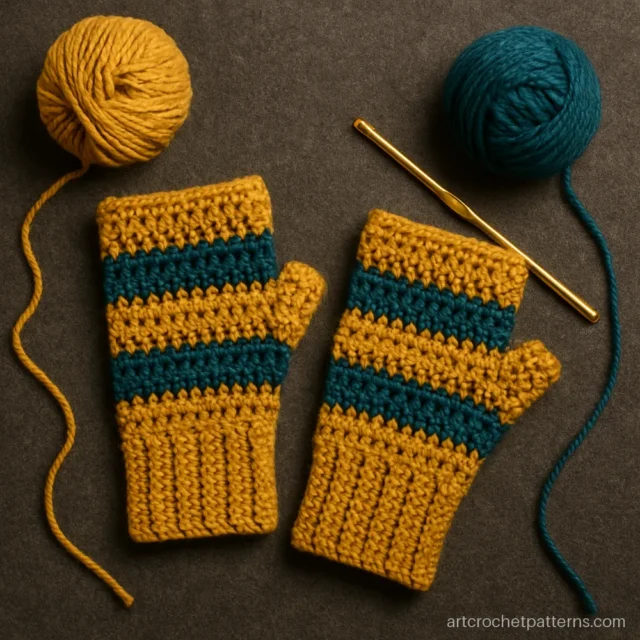 LevelEasyYarnWorsted (4) acrylicHook5 mm (H-8)
Striped texting mitts
Two row stripes in bold colors and a short worked thumb. The open top leaves fingertips free for a phone screen.
Maker note: Run the resting color loosely up the seam edge; each glove then has only four ends to weave.
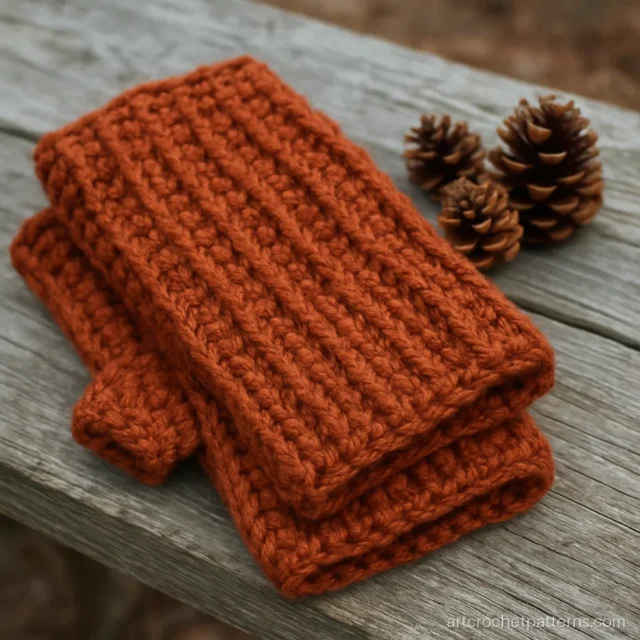 LevelBeginnerYarnBulky (5) woolHook6.5 mm (K-10.5)
Chunky rust hand warmers
Bulky wool makes a pair in one evening. These are warm enough to wear under mittens on very cold days.
Maker note: Bulky yarn makes thick seams. Sew with a thinner matching yarn instead of the working yarn.
 LevelEasyYarnDK (3) woolHook4.5 mm (7)
Moss stitch gloves with buttons
A tidy moss stitch grid and a short row of wooden buttons along the outer seam give these a tailored look.
Maker note: Sew buttons on through both layers of the seam so they stay firm.
Free fingerless gloves crochet pattern: the ribbed rectangle
You work short rows that run from fingertip edge to wrist edge. Because the ribs travel around the hand, the glove stretches sideways to slip on and then hugs your palm.
Supplies for one pair
- 120 to 160 yards of springy worsted wool or wool blend
- Hook: 5 mm, US letter H-8
- Tapestry needle and two pins
Gauge and fit
Across the ribs, fourteen hdc equal 4 inches; twelve back loop rows also equal 4 inches. Each glove is 7 inches long and wraps a 7.5 to 8 inch palm.
- Ch 26.
- Row 1: hdc in the 3rd ch from the hook and in each ch across. The 2 skipped ch do not count. (24)
- Row 2: ch 2 (does not count), turn, hdc in BLO of each st. (24)
- Rows 3 to 22: repeat Row 2. (24)
- Fasten off, leaving a 20 inch tail for sewing.
- Seam: fold the rectangle so Row 1 meets Row 22. Starting at the fingertip edge, whip stitch through the matching stitches for 5 sts. Skip the next 7 sts on both edges for the thumb gap. Whip stitch the last 12 sts down to the wrist. Fasten off.
- Thumb edge (optional): join yarn at the thumb gap, work 14 sc evenly around it, sl st to the first sc. Work 1 more round of sc. Fasten off. (14)
- Make a second glove the same way. Both gloves are identical, so either one fits either hand.
Wear each glove with its seam along the pinkie side of the hand. Weave tails into the seam allowance, where they will not show.
Hand sizes for crochet fingerless gloves
Circle a soft tape over the palm right below the knuckles, keeping the thumb outside it. Make the rectangle about half an inch smaller than that number so the ribbing grips.
| Hand | Rows to work | Palm measured | Thumb gap |
|---|---|---|---|
| Kid | 18 rows | 6 to 6.5 in | 6 sts |
| Small adult hand | 20 rows | 7 in | 6 sts |
| Medium hand | 22 rows | 7.5 to 8 in | 7 sts |
| Large or men's hand | 24 rows | 8.5 to 9 in | 8 sts |
For a longer cuff, chain 4 more for every extra inch and add those stitches to the wrist part of the seam, not the thumb gap.
How to crochet fingerless gloves that stay put
- Try it on early. After 10 rows, wrap the piece around your palm. You can see then whether you need more or fewer rows.
- Find the thumb on your own hand. Before seaming, fold the glove, slide it on and pin where the thumb joint sits. Hands differ, and the pin beats any number in a pattern.
- Seam through the back loops. A whip stitch through the outer loops of each edge lies flat and almost disappears in the ribbing.
- Snug the wrist. If the cuff slides, work one round of sc2tog every third stitch at the wrist edge, or thread a strand of elastic through the last row.
- Make the pair at once. Count rows on the first glove and write the number down. Gloves made weeks apart rarely match.
Choosing yarn for crochet gloves and hand warmers
| Fiber and weight | Hook range | How the glove behaves |
|---|---|---|
| Worsted wool | H-8 to I-9 | Warm, springy ribbing that keeps its grip |
| Worsted acrylic | H-8 | Washable and soft; may stretch out after many wears |
| DK merino | Size 7 (4.5 mm) | Thin enough to use a phone and type |
| Fine cotton | E-4 | Cool lace mitts for spring; no stretch |
| Bulky wool | K-10.5 | Very warm, very quick; bulky in a coat sleeve |
Wool wins for gloves: stretched over the knuckles a hundred times, it still returns to size. Read the label: superwash wool goes in the machine, while regular wool can felt.
When a glove fits badly
| What goes wrong | Reason | Sort it by |
|---|---|---|
| Thumb hole sits too high or low | Gap placed by the numbers, not by the hand | Unpick the seam and pin the gap while wearing it |
| Glove twists around the hand | Too many rows, so it is loose | Pull out two rows and reseam |
| Fingers feel squeezed | Rectangle too short or yarn has no stretch | Add rows; use wool, not cotton, for ribbing |
| Seam ridge rubs the palm | Seam on the inside or sewn too tight | Turn the glove so the seam is outside, under the little finger |
| The two gloves differ | Row count or tension changed | Lay them together and match row for row |
Gloves with fingers, mittens and matching sets
Full crochet gloves with fingers are an advanced project. Each finger is a small tube worked in the round from the hand, and the fit takes several tries. Most makers find crochet fabric too thick for full gloves and reach for crochet mittens instead, which have one thumb and one big pocket.
To build a set, make a crochet beanie and a crochet scarf in the same ribbing. For other quick cold weather pieces, the crochet ear warmer uses about the same yardage. The full list of wearable projects is on our crochet accessories hub.
Questions makers ask
Are fingerless gloves easy to crochet?
Yes, this style is one of the easiest wearables. You only work hdc in the back loop on a flat rectangle, then sew a seam with a gap. There is no shaping and no counting rounds.
How much yarn for one pair of fingerless gloves?
Two adult gloves in worsted take around 120 to 160 yards. Longer cuffs or bulky yarn can push it close to 200 yards.
Are crochet hand warmers and fingerless gloves the same thing?
Hand warmers and fingerless gloves usually mean the same thing: a tube for the hand with a thumb hole and open fingers. Gloves have a separate tube for each finger.
How do I make the thumb longer?
Work more rounds of sc around the thumb gap. Each round adds about a quarter inch. Decrease two stitches on the third round so the thumb tapers.
Can I make these gloves in the round instead?
Yes. Chain to fit the wrist, join and work rounds up to the thumb, then chain a few stitches over the thumb gap and keep going. The flat rectangle is simpler for a first pair.
Why do my gloves stretch out after wearing?
Acrylic and cotton do not spring back the way wool does. Wash and dry them flat to tighten them, or make your next pair two rows smaller in wool.