
This hexagon crochet pattern gives you a classic granny hexagon with exact counts for every round, plus six ideas for turning a pile of six sided motifs into something useful. A crochet hexagon grows from six corners instead of four, so it fits together like a honeycomb with no gaps.
If you have made a granny square, you already know the clusters. The only change is two extra corners, and that small change lets you build blankets, bags, cardigans and even a soccer style ball.
At a glance
Skill level
EasyStitches used
Ch, sl st, dc in clustersYarn
Worsted acrylic or cottonHook
5 mm (H-8)Motif size
About 5 1/2 in point to point after 4 roundsTime
15 to 20 minutes per motif
6 hexagon crochet pattern designs to make
Every design lists the skill level, yarn and hook, with a note from the maker.
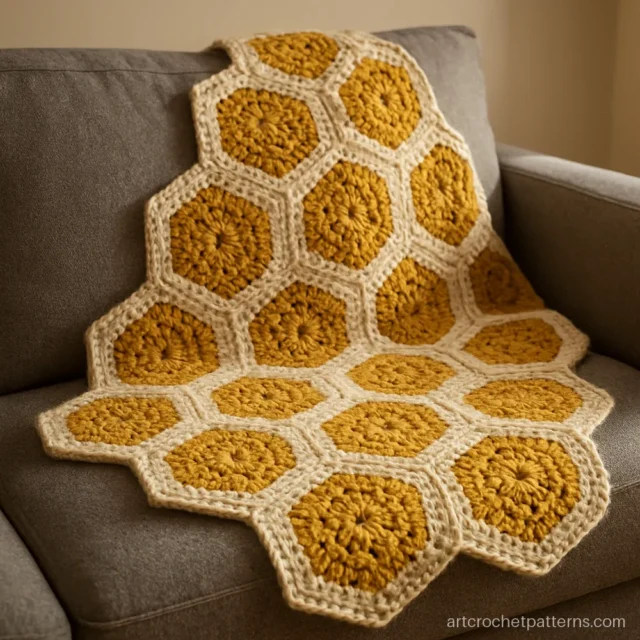 LevelEasyYarnWorsted acrylicHook5 mm (H-8)
Honeycomb throw in mustard
Two colors only: mustard centers with a cream last round. The single border color makes the honeycomb outline pop.
Maker note: A 50 by 60 inch throw takes roughly 150 motifs of this size, so cut ends as you go.
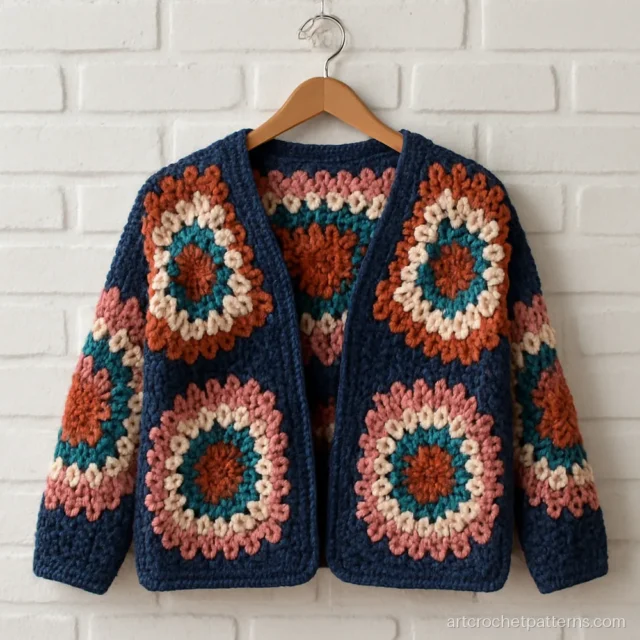 LevelIntermediateYarnWorsted acrylicHook5.5 mm (I-9)
Scrappy hexagon cardigan
Two large hexagons folded and seamed make a cardigan with sleeves. Scrap colors in the middle and navy at the edge tie it together.
Maker note: Each hexagon grows until its width equals your wrist to wrist measure divided by two, plus ease.
 LevelBeginnerYarnWorsted cottonHook4.5 mm (7)
Sage cotton coasters
Three rounds make a coaster just the right size for a mug. Cotton soaks up drips and holds its shape in the wash.
Maker note: Stop after Round 3 and add a round of sc, 3 sc in each corner space, for a solid edge.
 LevelEasyYarnWorsted cottonHook5 mm (H-8)
Ecru hexagon market bag
Lacy hexagons with chain spaces stretch around groceries and fold small. Seven motifs per side plus a band at the top.
Maker note: Join with sl st through back loops so the seams lie flat and add no bulk.
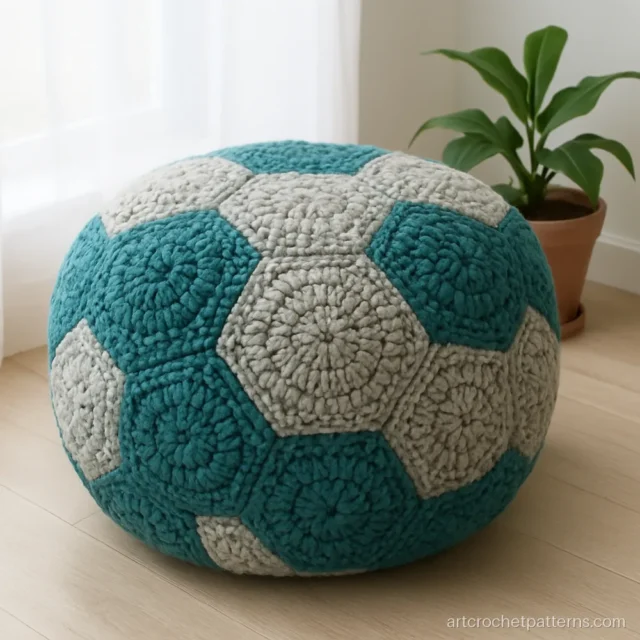 LevelIntermediateYarnBulky acrylicHook8 mm (L-11)
Chunky hexagon pouf cover
Big hexagons in chunky yarn sewn around a foam cylinder. Two motifs form the top and bottom.
Maker note: Make the side panel motifs two rounds smaller than the top so the cover hugs the foam.
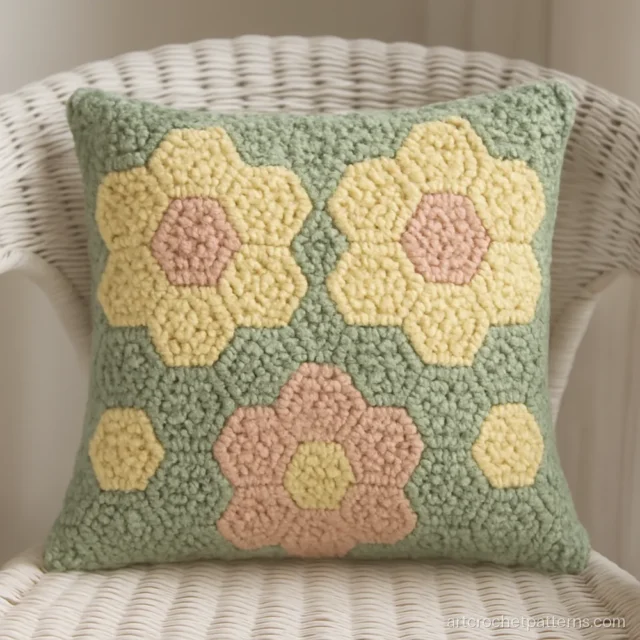 LevelEasyYarnDK cottonHook4 mm (G-6)
Flower garden pillow
Seven hexagons make one flower: a yellow center ringed by six pink petals. A pillow front holds two flowers and some green filler motifs.
Maker note: Lay out every motif on the floor before joining, and take a phone photo so you can follow it.
Granny hexagon crochet pattern, round by round
Each round adds six clusters, one per side, so the motif stays flat. Change color at the start of any round if you like.
Materials: worsted acrylic or cotton, about 25 yards per 4 round motif; 5 mm (H-8) hook; tapestry needle.
Size: about 5 1/2 inches from point to point after Rnd 4. Ch 3 at the start of a round counts as the first dc. A cluster is 3 dc worked into the same space.
- Ch 4, join with sl st to form a ring (or use a magic ring).
- Rnd 1: ch 3, 2 dc in ring, ch 2, (3 dc in ring, ch 2) 5 times, join with sl st to top of beg ch 3 (6 clusters, 18 dc, 6 ch-2 corners).
- Rnd 2: sl st in next 2 dc and into the first ch-2 space. Ch 3, (2 dc, ch 2, 3 dc) in same space, ch 1, *(3 dc, ch 2, 3 dc) in next ch-2 space, ch 1; rep from * 4 more times, join to top of beg ch 3 (12 clusters, 36 dc).
- Rnd 3: sl st in next 2 dc and into the corner space. Ch 3, (2 dc, ch 2, 3 dc) in same space, ch 1, 3 dc in next ch-1 space, ch 1, *(3 dc, ch 2, 3 dc) in next corner, ch 1, 3 dc in next ch-1 space, ch 1; rep from * 4 more times, join (18 clusters, 54 dc).
- Rnd 4: sl st to the corner space as before. Ch 3, (2 dc, ch 2, 3 dc) in same space, *(ch 1, 3 dc in next ch-1 space) twice, ch 1, (3 dc, ch 2, 3 dc) in next corner; rep from * 4 more times, (ch 1, 3 dc in next ch-1 space) twice, ch 1, join (24 clusters, 72 dc).
- For bigger motifs keep going: every round adds one cluster to each side (Rnd 5: 30 clusters, 90 dc).
When you change colors, start the new round in a different corner each time. The joins then scatter around the motif instead of stacking into a visible seam line. Weave each tail through the clusters of its own color.
Which yarn makes which size crochet hexagon
| Yarn weight | Hook | Four round motif | Use it for |
|---|---|---|---|
| Fingering | 3 mm | About 3 1/2 in | Light shawls, baby cardigans |
| DK | 4 mm (G-6) | About 4 1/2 in | Pillows, tops |
| Worsted | 5 mm (H-8) | About 5 1/2 in | Blankets, bags, coasters |
| Bulky | 8 mm (L-11) | About 8 in | Poufs, rugs, quick throws |
Sizes are rough. Your tension changes them, so make one motif and measure before you plan a big piece.
Joining hexagons so they lie flat
Hexagons meet three at a point. That point is where most gaps appear, so take extra care there.
- Lay out the whole piece. Rows of hexagons offset by half a motif, like bricks with angled ends.
- Join in strips. Join one row, then attach the next row along its zigzag edge.
- Choose a seam. A whip stitch through back loops is invisible from the front. A sl st seam on the right side makes a raised ridge you can show off. The guide on joining crochet squares shows both, and they work the same on six sides.
- Work into the corner spaces of all three motifs where they meet, so no hole is left.
Filling the edges of a hexagon blanket
A honeycomb has a zigzag edge. To make a straight side, crochet half hexagons for the gaps. Work them in rows: ch 4 ring, then turn after every row so you build only three of the six sides. Add a blanket border of sc or hdc after that. If you like the zigzag, keep it and follow the points with a round of sc, placing 3 sc in each outer corner and sc2tog where two motifs meet at an inner corner.
Hexagon problems and how to solve them
| Sign | Likely cause | Solution |
|---|---|---|
| Motif cups like a bowl | Corners too tight or missing ch 1 between clusters | Check for ch 2 at every corner and ch 1 between clusters |
| Motif ruffles | Extra cluster crept into a side | Count clusters per side: Round number minus 1 between corners |
| Only five corners | A repeat was skipped | Count ch-2 corners at the end of every round |
| Motifs differ in size | Tension changed over days | Measure each motif against the first and block them all |
| Holes where three meet | Seam skipped a corner space | Pass the needle through all three corner spaces |
More ideas with six sides
Hexagons fold into shapes squares cannot. Twelve pentagons plus twenty hexagons build a ball. A long strip of hexagons, folded, becomes a cowl. A single big hexagon, folded in half and seamed at the ends, gives a simple shrug. For other motifs that start in the center, look at the mandala crochet pattern, and for more stitch ideas visit the crochet stitches hub.
Questions makers ask
How many hexagons do I need for a blanket?
With motifs about 5 1/2 inches across, a 50 by 60 inch throw needs roughly 150, and a crib blanket of 45 by 60 inches needs roughly 135. Hexagons nest, so count rows and motifs per row on a sketch before you start.
Is a crochet hexagon harder than a granny square?
No. It uses the same clusters and chain spaces. You just work six corners instead of four, so counting the corners each round is the main new habit.
Why does my hexagon not lie flat?
Usually a missing chain between clusters, or a skipped corner. Count six corners and check that each side has the same number of clusters. Blocking fixes small waves.
Can I make a solid hexagon with no holes?
Yes. Leave out the ch 1 between clusters and work the clusters right next to each other, keeping ch 2 at the corners. The motif will be a little smaller and denser.
How do I make a half hexagon?
Work in rows instead of rounds, building three sides only. Turn after every row and begin with ch 3. It fills the zigzag edge of a hexagon blanket.
What yarn works best for a hexagon cardigan?
A soft worsted or DK acrylic or wool blend. It drapes better than cotton, which can feel heavy and stiff in a garment of joined motifs.