
Tunisian crochet stitches load a long hook with a full row of live loops as you travel left, then lock them off as you travel back. That two part rhythm makes a thick, dense fabric that can look woven, knitted or ribbed depending on where you put the hook.
Nearly every Tunisian stitch uses the same return pass. Only the forward pass changes. Once you learn the simple stitch, the knit, purl, full, honeycomb and double stitches below are small changes to the same move. If you are brand new, start with the Tunisian crochet basics guide first.
At a glance
Skill level
Beginner to intermediateHook
Long Tunisian hook, 2 to 3 sizes upYarn
Smooth worsted or DKEach row
Forward pass plus return passRight side
Always facing you, no turningAlso called
Afghan stitch (simple stitch)
Six Tunisian crochet stitches to learn
Tunisian simple stitch (Tss)
Pass over the edge bar. Slide the hook right to left beneath the next upright front bar, wrap, and lift a loop. Repeat across. This is the classic afghan stitch, a firm grid good for cross stitch on top.
Tunisian knit stitch (Tks)
Aim for the center of the next V: stab straight through the fabric, between its two upright legs and below the sideways strands, then wrap and lift a loop. It forms V columns that look like knitting.
Tunisian purl stitch (Tps)
Bring the yarn to the front of the work. Insert the hook under the next front vertical bar as for Tss, wrap toward the back, and draw that strand through. A small horizontal bump sits in front of each stitch.
Tunisian full stitch (Tfs)
Insert the hook into the space between two vertical bars, under the horizontal strands, and pull up a loop. Each row shifts by half a stitch, which gives a dense, thick fabric that does not curl much.
Honeycomb stitch
Alternate Tss and Tps across the row. On the next row, work Tps above each Tss and Tss above each Tps. The bumps form a soft honeycomb.
Tunisian double stitch (Tdc)
Wrap first, slip under the next upright bar, wrap and lift, then wrap and close through 2. Each Tdc leaves a single new loop behind. Taller and more open, good for wraps.
In pictures
What the work should look like, with the yarn and hook used for each sample.
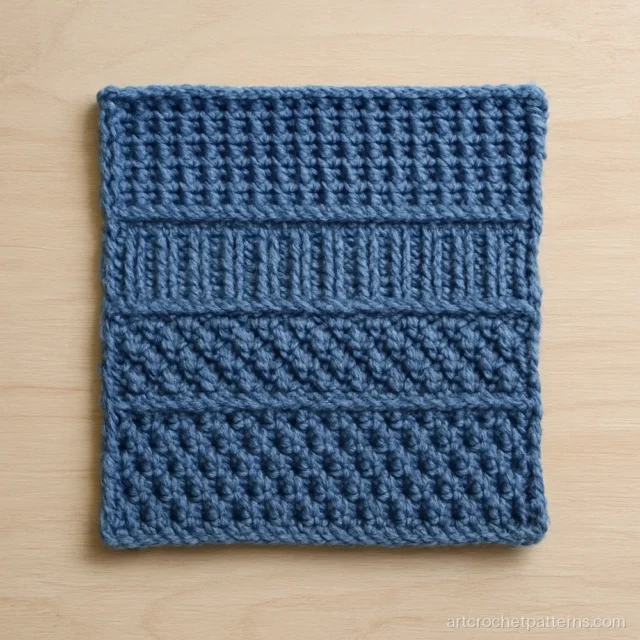 LevelBeginnerYarnWorsted acrylicHook6.5 mm Tunisian
Four stitch sampler in denim blue
One swatch, four bands. You can see the grid of simple stitch, the V of knit stitch and the bumps of purl and honeycomb.
Maker note: Work 6 rows of each stitch so the change in texture is easy to compare.
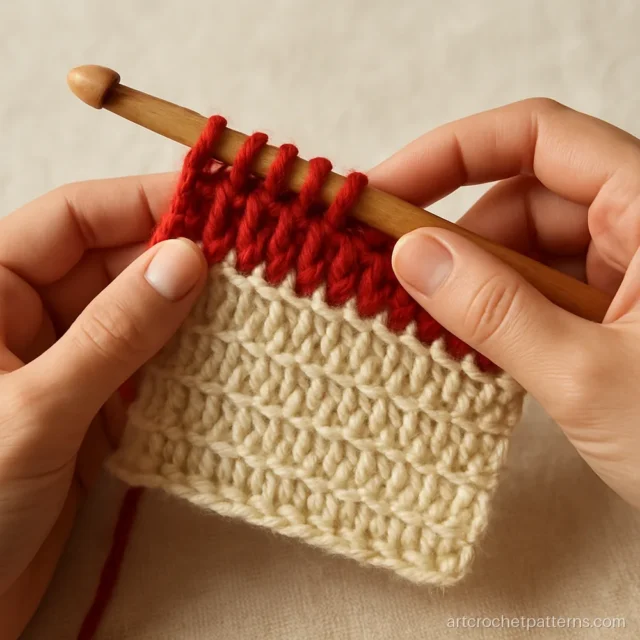 LevelBeginnerYarnWorsted woolHook6 mm Tunisian
Loops on the hook in the forward pass
Going out, each stitch adds a loop to the shank. Coming back, those loops get closed off in pairs.
Maker note: Size every loop on the fat part of the shank, never up near the narrow throat.
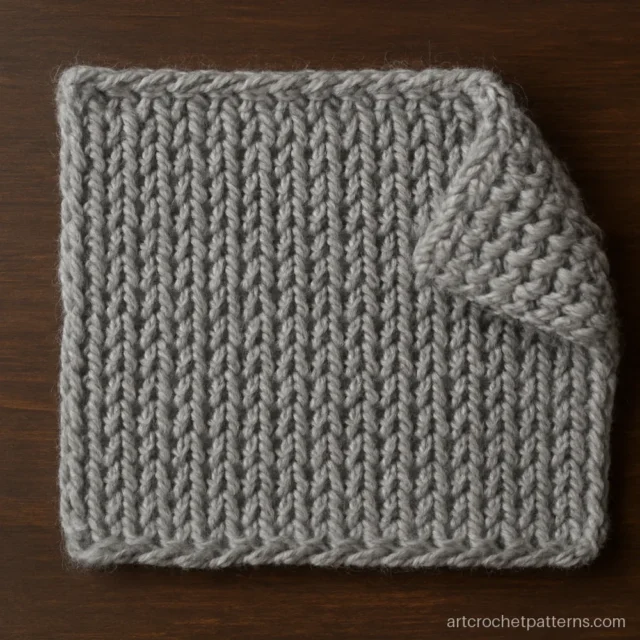 LevelIntermediateYarnDK woolHook5.5 mm Tunisian
Knit stitch close up
The knit stitch makes rows of V shapes so close to stockinette that many people cannot tell the difference.
Maker note: Keep the knit stitch loose; it is the tightest Tunisian stitch to work into.
Sampler swatch: try four stitches in one piece
For this sampler, pair worsted with a long hook sized 6.5 mm. Each row counts as a forward pass and its matching return.
- Ch 16.
- Row 1 forward: Insert hook in 2nd ch from hook, yo, pull up a loop. Pull up a loop in each ch across. (16 loops)
- Row 1 return: Yo, pull through 1 loop. *Yo, pull through 2 loops; rep from * until 1 loop remains. (1 loop)
- Rows 2 to 7 forward: Skip first vertical bar. Tss in each st to last st. For the last st, insert under the last vertical bar and the strand behind it, pull up a loop. (16 loops)
- Rows 2 to 7 return: As Row 1 return.
- Rows 8 to 13: Work as Row 2, but Tks in each st to last st, then the last st as before. (16 loops)
- Rows 14 to 19: Work as Row 2, but Tps in each st to last st. (16 loops)
- Rows 20 to 25: Honeycomb. On even rows, *Tss, Tps; rep from * to last st. On odd rows, *Tps, Tss; rep from * to last st. Work the last st as before. (16 loops)
- Bind off: skip first bar, *insert as for Tss, yo, pull through the bar and the loop on the hook; rep across (a sl st bind off). Fasten off.
With 16 loops, the first and last are edge stitches, leaving 14 pattern stitches, an even number, so honeycomb pairs fit exactly.
Hook and yarn for Tunisian stitches
| Yarn | Tunisian hook | Result |
|---|---|---|
| DK | 6 mm; loose hands can drop half a size | Light scarves and baby items |
| Worsted | 6.5 mm | Classic blanket and pillow fabric |
| Aran | 8 mm | Warm throws, fast to work |
| Bulky | 9 or 10 mm | Very thick rugs and mats |
Tunisian fabric is far denser than regular crochet, so go up 2 or 3 sizes from the yarn label. Use a long straight hook for narrow pieces and a hook with a cable for blankets. Our Tunisian crochet hook page explains lengths, cables and grips.
Curling, slanting and other Tunisian woes
| What goes wrong | Behind it | Try instead |
|---|---|---|
| Fabric rolls toward you | Hook too small or return pass tight | Go up a size and relax the return pass |
| Left edge is loose and loopy | Last stitch worked under one strand | Pick up the last bar and the strand behind it |
| Stitch count shrinks | First bar not skipped, or last st missed | Count loops on the hook after each forward pass |
| Knit stitch is hard to insert | Return pass too snug | Use a larger hook for Tks rows |
Where to use each stitch
Tss makes firm dishcloths and a grid for embroidery. Tks suits hats and sweaters where you want a knitted look. Honeycomb and Tps give warm blanket texture, and Tdc drapes well in wraps. For complete projects that put these stitches to work, browse the Tunisian crochet patterns, and compare them with regular crochet in the crochet knit stitch guide and the main crochet stitches library.
Questions makers ask
What is the easiest Tunisian crochet stitch?
The Tunisian simple stitch. You slide the hook under one vertical bar per stitch, and it teaches the forward and return pass that every other stitch uses.
Why is my swatch curling toward me?
Tunisian fabric pulls toward the front, especially in simple and knit stitch. Use a hook 2 or 3 sizes larger than the label, keep the return pass loose, and block the finished piece.
Can my regular hook handle Tunisian stitches?
For anything wider than a few inches, yes. The loops need room, so pick a long straight shank or one with a flexible cable. A regular hook works for a very small swatch.
Which Tunisian stitch looks like knitting?
The Tunisian knit stitch. It forms V columns on the front that look very close to knitted stockinette.
Is Tunisian worked back and forth with turns?
Never. Its front stays toward you. You work the forward pass from right to left and the return pass from left to right, or the mirror image if you are left handed.
What loop count should I see after a forward pass?
One loop for each stitch in the row, counting the first loop. Count after every forward pass while you learn.