
Bean stitch crochet packs two or three loops into one stitch and closes them together, so each stitch puffs up into a small oval bean. The fabric is thick, soft and a little bumpy, a lot like a row of coffee beans lying on their sides.
Below you will learn the mini bean stitch first, because it uses only two pulled up loops and is the easiest version to keep even. Then you can try the fuller bean, a practice swatch with exact counts, and the mistakes that make beans lean or gap.
At a glance
Skill level
Easy, once you know single crochetYarn
Worsted acrylic, wool or cottonHook
5 mm to 5.5 mm (H-8 to I-9)Stitches used
ch, sc, mini bean, yoGood for
Washcloths, hats, cozy blanketsStitch multiple
Odd number of sc
What makes a bean different from a puff
A bean and a puff stitch look alike, and they are close cousins. The difference is the very first move. A puff opens with a wrap of yarn around the hook, then goes into the stitch. A bean goes into the stitch first and pulling up a plain loop, then adds yarn overs between the next loops. That small change keeps the bean shorter and tighter than a puff.
Beans are also softer than a bobble, which is built from half finished double crochets. A bean never gets that tall, so it works well in rows and does not need a wrong side row to pop.
How to work the mini bean stitch crochet step by step
- Insert the hook into the stitch, wrap the yarn once and draw a loop back out. You have 2 loops on the hook.
- Yarn over. Now there are 3 loops. Do not pull this one through anything.
- Insert the hook into the same stitch, wrap and draw out a second loop. You have 4 loops on the hook.
- Raise every loop to single crochet height. Short loops make a flat bean.
- Wrap once more and pull through all 4 loops together. One mini bean is done.
- Chain 1 to lock the top. The chain also becomes the small gap you skip over in the next row.
In pictures
What the work should look like, with the yarn and hook used for each sample.
 LevelEasyYarnWorsted woolHook5 mm (H-8)
Mini bean swatch in mustard wool
A worsted wool swatch shows the mini bean at its best: each bean sits upright with a tiny chain gap beside it.
Maker note: Give each loop the height of a single crochet; loops left short squash the bean flat.
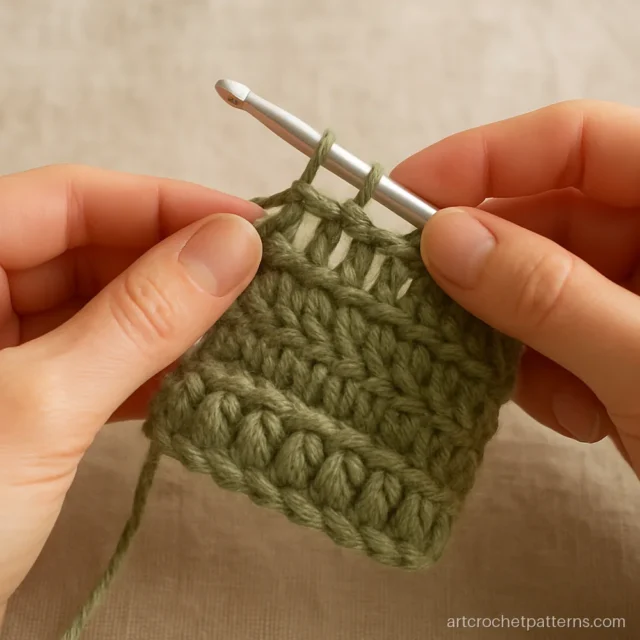 LevelEasyYarnWorsted acrylicHook5.5 mm (I-9)
Pulling up loops for one bean
Four loops on the hook mean the mini bean is ready to close. Keep them the same height so they slide off together.
Maker note: If the last yarn over will not slide through, tilt the hook throat down and ease the loops toward the tip one at a time.
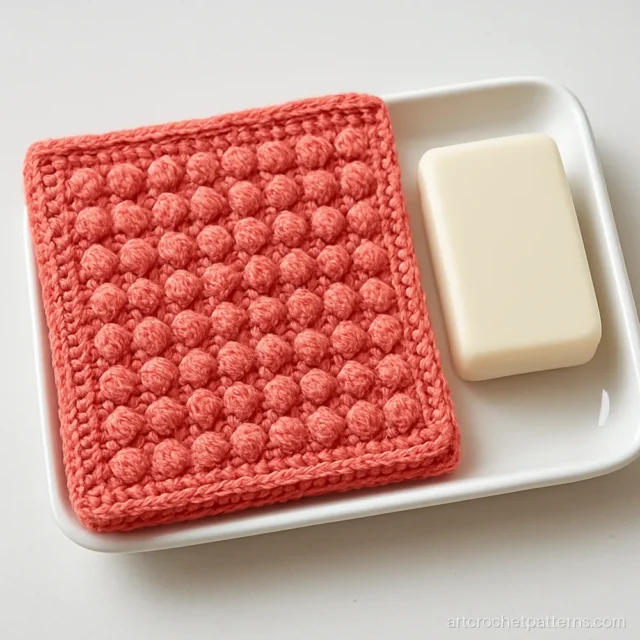 LevelEasyYarnWorsted cottonHook5 mm (H-8)
Coral cotton bean washcloth
Cotton beans give a gentle scrub without feeling rough. Twenty rows of the swatch below make a cloth about 7 inches square.
Maker note: Cotton has no stretch, so keep your loops a touch looser than you would with wool.
The full bean stitch
For a bigger, rounder bean, keep going in the same stitch. After step 3 above, yarn over again, insert into the same stitch and pull up a third loop. That leaves 6 loops on the hook. Yarn over, draw through all 6, then chain 1 to close.
The full version eats more yarn and makes a denser fabric, so it suits a winter hat or a heavy throw. The mini version is lighter and kinder to tired wrists, so most washcloth and baby blanket patterns use it.
Practice swatch in the mini bean stitch
This swatch keeps a single crochet at each edge so the sides stay straight. Worked in medium weight yarn on an H-8 hook, it measures close to 6 inches across.
- Ch 20.
- Row 1: Sc in 2nd ch from hook and in each ch across. Turn. (19 sc)
- Row 2: Ch 1 (does not count as a st), sc in first sc, *mini bean in next st, ch 1, sk next st; rep from * 7 more times, mini bean in next st, sc in last st. Turn. (2 sc, 9 mini beans, 8 ch-1 sps: 19 sts)
- Row 3: Ch 1, sc in first sc, *mini bean in top of next bean, ch 1, sk next ch-1 sp; rep from * 7 more times, mini bean in top of next bean, sc in last sc. Turn. (19 sts)
- Rows 4 to 20: Rep Row 3.
- Last row: Ch 1, sc in each sc, bean and ch-1 sp across. (19 sc) Fasten off and weave in the ends.
The ch 1 after each bean is the gap. On the next row you step over it and put the new bean into the top of the old one, so the beans stack in columns. In the count, each bean and each ch-1 space is one stitch. If your count drifts, check the two edge single crochets first.
Choosing yarn and hook for crochet bean stitch
| Bean fabric you want | Yarn to pick | Hook size |
|---|---|---|
| Fine and pebbly, for a baby cardigan | Sport weight (2) | G-6, which is 4 mm |
| Light blanket beans you can still see clearly | DK (3) | 4.5 mm, or H-8 if you crochet tight |
| Classic plump beans for cloths and hats | Worsted (4) | H-8 or I-9 |
| A very thick, quick throw that drinks yarn | Bulky (5) | K-10.5 up to L-11 |
Smooth, plied yarn shows each bean best. A fuzzy brushed yarn or a velvet chenille blurs the ovals, so save those for plainer stitches like half double crochet.
Common bean stitch mistakes and fixes
| What your beans do | The cause | How to put it right |
|---|---|---|
| Beans look flat | Loops pulled up too short | Lift each loop to single crochet height before the next step |
| Hook gets stuck closing | Loops are tight or uneven | Go up half a millimeter, or loosen each loop as you pull it up |
| Swatch grows wider | Skipped the ch-1 space twice or worked into it | Work only into bean tops and edge sc; count 19 at each row end |
| Beans lean to one side | Normal for this stitch in turned rows | Block the finished piece; the lean evens out across rows |
| Holes between beans | Chain 1 is too loose | Snug the closing chain against the top of the bean |
Where the bean stitch works best
Beans trap air, so the fabric feels warm for its weight. Try it for a hat brim folded up over a plain crown, a chunky cowl, or the center panel of a baby blanket with a plain blanket border. In cotton it makes a dishcloth that scrubs gently. Other bumpy choices live in our crochet stitches index; you can also compare it with the textured crochet stitches guide.
Questions makers ask
What is the difference between bean stitch crochet and mini bean stitch?
The mini bean pulls up two loops in one stitch and closes with 4 loops on the hook. The full bean pulls up three loops and closes with 6. The mini is smaller, lighter and easier to keep even.
Can a new crocheter learn the crochet bean stitch?
Most people manage it within an hour once their single crochet tension is steady. The only new skill is counting loops on the hook. Practice the swatch above before starting a big project.
How much extra yarn do beans need?
Every bean holds extra loops, so the fabric is hungrier than plain single crochet. Plan on roughly one third more yarn than a flat single crochet piece of the same size, and buy all your yarn from one dye lot.
Why does my bean stitch fabric curl?
Tight loops pull the fabric in on one side. Go up a hook size, keep loops tall, and block the piece flat when it is done. Edge single crochets also help it lie straight.
Can I work bean stitch in the round?
Rounds suit beans well. Close every lap with a slip stitch, chain 1, and carry on with beans and ch-1 gaps just as the flat swatch does. Use an even number of stitches so the repeat closes neatly at the join.