
A crochet scrunchie is worked directly onto a plain hair elastic, so there is no sewing, no casing and no threading of elastic later. You cover the band with single crochet, then build two rounds of ruffles that bunch up when the tie relaxes.
One takes about 30 minutes and 40 yards of yarn, which makes scrunchies a good way to practice working into a ring and to use the last bits of a cotton skein. Six designs and one complete pattern sit below.
At a glance
Skill level
BeginnerYarn
DK (3) or worsted (4) cotton, 35 to 45 yardsHook
4 mm (G-6)Time
30 to 45 minutesStitches used
sc, dc, ch, sl stBase
Plain hair elastic, about 2 inches across
6 crochet scrunchie designs to make
Every design lists the skill level, yarn and hook, with a note from the maker.
 LevelBeginnerYarnDK (3) cottonHook4 mm (G-6)
Double ruffle scrunchie in dusty rose
Written out in full further down: a round of double crochet doubles the stitch count, and chain loops make a frilly edge. Cotton gives crisp ruffles that do not droop.
Maker note: Push the single crochet together along the elastic as you go. Packed stitches make a fuller ruffle.
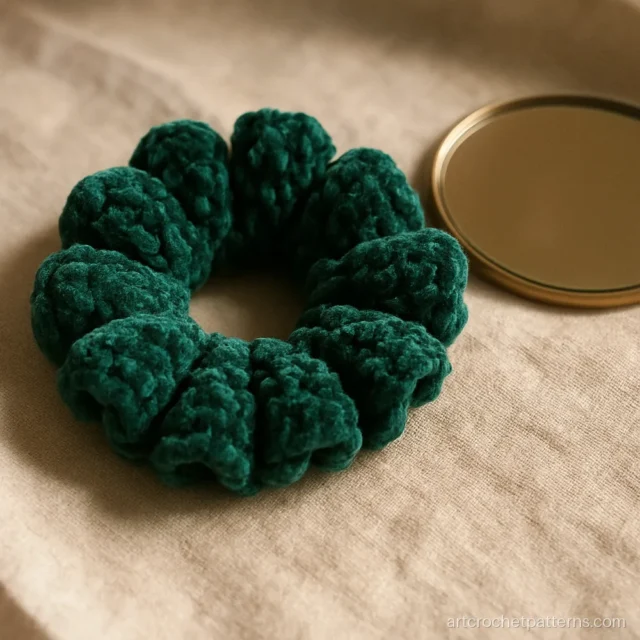 LevelEasyYarnBulky (5) chenilleHook5 mm (H-8)
Plush chenille scrunchie
Chenille looks like velvet and slides off hair without pulling. It hides stitches, so count by feel and keep the pattern to plain rounds.
Maker note: Chenille is hard to rip back, so test your stitch count around the elastic once before you commit.
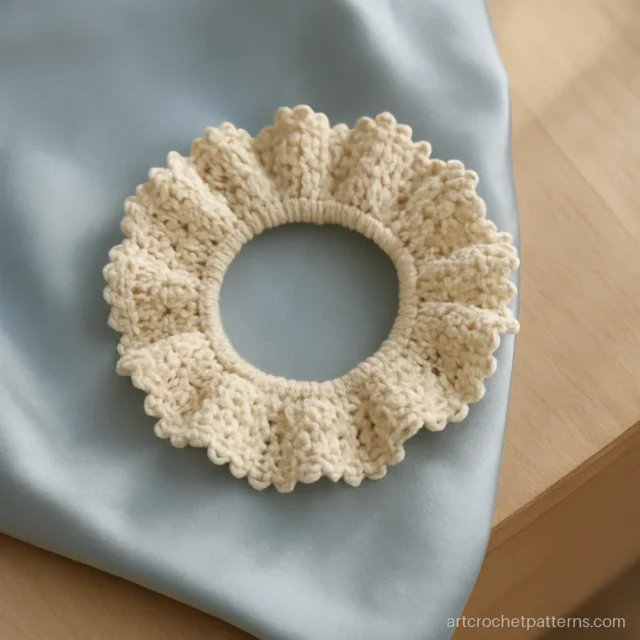 LevelEasyYarnFingering (1) cottonHook2.75 mm (C-2)
Fine thread scrunchie for silky hair
Thin mercerized cotton makes a gentle tie for fine hair and for sleeping. A picot edge adds detail without bulk.
Maker note: Use a thinner elastic, about 1.5 inches across, so the tie does not slip out of fine hair.
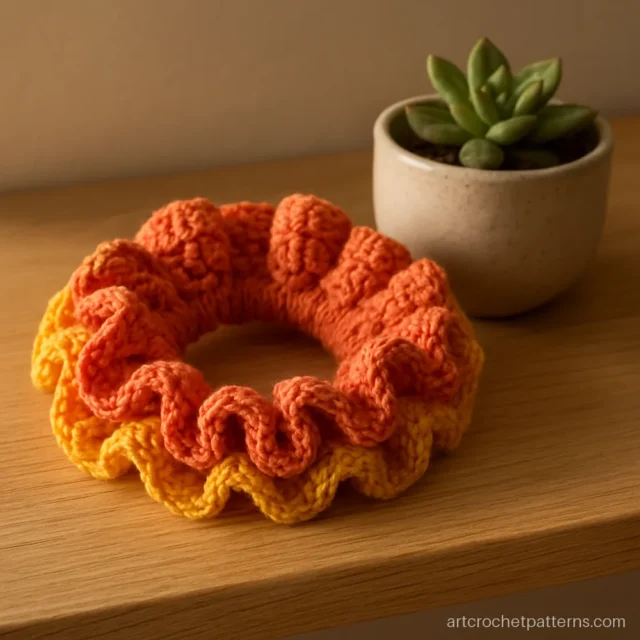 LevelBeginnerYarnWorsted (4) cotton scrapsHook4.5 mm (7)
Sunset stripe scrap scrunchie
Each ruffle round is a new color, so one scrunchie can use three small leftovers. Warm shades read like a sunset when the tie bunches up.
Maker note: Bring in each new shade on the joining slip stitch. Trim and hide every tail inside the ruffle.
 LevelEasyYarnWorsted (4) acrylicHook4.5 mm (7)
Scrunchie with a crochet bow
A small rectangle cinched in the middle becomes a bow, and it sits on a simple single crochet scrunchie. Sew it through several stitches so it stays upright.
Maker note: Work the bow rectangle in rows of 10 sc for 6 rows, then wrap the center with the tail.
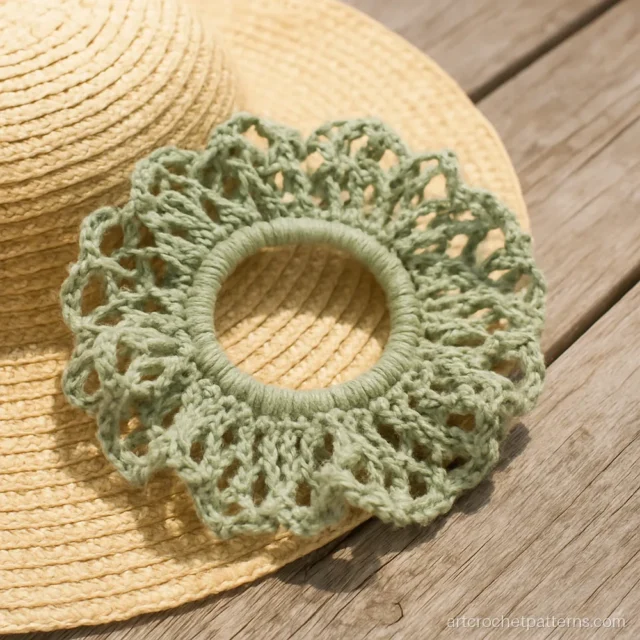 LevelBeginnerYarnDK (3) linen cotton blendHook4 mm (G-6)
Airy mesh summer scrunchie
Chain loops replace the solid double crochet round, so the tie is light and dries fast after a swim. Linen blend softens with every wash.
Maker note: Make every loop the same length. Uneven loops show more on an open design than on a solid one.
How to crochet a scrunchie onto a hair tie
The whole trick is in the first round. Instead of chaining, you work single crochet stitches around the elastic itself, as if the band were a ring.
- Tie a slip knot and set it on your hook. Hold the elastic in your left hand.
- Poke the hook into the middle of the elastic ring, yarn over, and pull a loop back through. Wrap again and draw it through the two loops you now hold. That is your first single crochet, wrapped around the band.
- Keep going around. After every 10 stitches, slide them together so the elastic is packed tight and none of it shows.
- When you are back at the start, close the round by slip stitching into stitch one.
If single crochet is still new, practice it flat with the single crochet lesson first. Working around the band feels odd for the first few stitches and then becomes automatic.
Crochet scrunchie pattern with a double ruffle
Materials: about 40 yards DK cotton, one hair elastic about 2 inches across, 4 mm (G-6) hook, yarn needle. Finished size: about 4.5 inches across when relaxed.
- Rnd 1: join yarn with a slip knot, sc around the elastic 64 times, sliding stitches together as you go, join with sl st to first sc (64)
- Rnd 2: ch 3 (counts as dc), dc in same st, 2 dc in each st around, join with sl st to top of ch 3 (128)
- Rnd 3: ch 1, sc in first st, *ch 3, sk 1 st, sc in next st; rep from * until 1 st remains, ch 3, sk last st, join with sl st to first sc (64 sc, 64 ch-3 loops)
Fasten off and weave in ends.
The count in Rnd 1 depends on your elastic and yarn. Anything from 56 to 72 stitches works, as long as the band is fully hidden and the number is even. Rnd 2 always doubles it, and Rnd 3 always gives half that number of loops.
For a tighter, more modest ruffle, work Rnd 2 as 2 dc in one stitch and 1 dc in the next all around. That gives 1.5 times the base count instead of double.
Picking yarn for crochet scrunchies
Hair ties get pulled, twisted and washed more than most accessories. Smooth fibers glide over hair. Fuzzy ones catch and tangle.
| Fiber | How it behaves in hair | Best for |
|---|---|---|
| Mercerized cotton | Smooth with a slight shine, holds ruffles | Everyday ties |
| Chenille | Very soft, gentle on curls | Thick or curly hair |
| Acrylic | Light and stretchy, comes in every color | Kids and gifts in bulk |
| Linen blend | Crisp at first, softens with wear | Summer and the pool |
| Mohair or brushed yarn | Fuzz grabs and pulls hair | Avoid |
More on fiber choice lives in the cotton yarn guide.
What goes wrong and how to save it
| Trouble | What caused it | Way out |
|---|---|---|
| Elastic peeks through | Too few stitches in Rnd 1 | Add stitches and pack them tighter before joining |
| Ruffle flops flat | Hook too big or yarn too soft | Use cotton and a 4 mm hook, or drop to 3.5 mm |
| Tie will not stretch | Stitches pulled tight around the band | Keep Rnd 1 snug but not strangled; the band must still open fully |
| Ruffle twists to one side | Rnd 2 started in the wrong spot after joining | Always work the first dc into the same stitch as the ch 3 |
Gift and selling ideas
Scrunchies are one of the fastest small gifts you can make. Tie three in matching colors with a strip of fabric for a teacher gift, or make one to match a crochet headband. They also fill a market table: a stack in graded shades of one color looks neat and sells better than a jumble.
Find more quick pieces in all our accessories, or try a bow to stitch on top from the crochet bow page.
Questions makers ask
Which elastic size suits a crochet scrunchie?
A plain fabric covered hair elastic about 2 inches across suits most hair. Use a 1.5 inch elastic for fine hair or kids, and a thick 2.5 inch band for heavy, curly hair. Seamless bands are smoother inside than ones with a metal joint.
Can I make crochet scrunchies without an elastic?
Yes. Chain about 60 and join the ends, then build every round on that chain circle. Then thread a length of 0.25 inch flat elastic through the base round and knot it. The elastic method is quicker and stronger, though.
How much yarn does one scrunchie use?
About 35 to 45 yards for the double ruffle in DK cotton. A plain version with only one round of sc and one round of dc takes roughly 20 yards, so a single skein of cotton makes a whole set.
Can a crochet scrunchie go in the washing machine?
Swish it through cool sudsy water, squeeze gently, and leave it spread on a towel overnight. Hot water and the dryer wear out the elastic quickly. Cotton ruffles can be reshaped with your fingers while damp.
Why is my scrunchie lopsided?
Usually the stitches on the elastic are bunched in one area and sparse in another. Before joining Rnd 1, spread them evenly all the way around. Each later round follows that first spacing.