
The herringbone half double crochet is a regular half double with one small change: you pull the new loop through the stitch and the first loop on your hook in a single motion. That twist tilts every stitch, so rows lean like the bones of a fish and the fabric gets a soft woven look.
It works up as fast as plain half double, it is slightly shorter and denser, and it drapes better than you might expect. If you can already make a half double crochet, you can learn this in one sitting.
At a glance
Skill level
Easy (know hdc first)Abbreviation
HHdcYarn
Smooth worsted or DKHook
5 mm (H-8) for worstedTurning chain
Ch 2, does not countGood for
Cowls, blankets, beanies
Herringbone half double crochet step by step
Start with a chain. For a test piece, chain 22 in a worsted yarn with a 5 mm hook.
- Wrap once. Yo as if for a normal half double. Two loops sit on the shank.
- Go in. On Row 1 that means the third chain counted back from the hook; later rows use the next stitch.
- Catch and drag. Yo, haul that strand up out of the stitch and keep moving: that same new loop passes straight through the wrap that sat nearest the hook tip. Two loops remain, not three.
- Close it. Yo and draw through the last pair. The finished stitch sits a touch shorter than a regular hdc and tips slightly sideways.
That pull through is the whole stitch. Say it in your head as you go: over, in, pull through two, over, through two.
Practice swatch with stitch counts
This swatch teaches the rhythm and shows how the rows lean. In US terms, HHdc is the herringbone half double; in UK terms it is a herringbone half treble.
- Ch 22.
- Row 1: HHdc in 3rd ch from hook and in each ch across. The 2 skipped chains do not count as a stitch. (20)
- Row 2: Ch 2 (does not count), turn. HHdc in first st and in each st across. Do not work into the turning chain. (20)
- Rows 3 to 16: Rep Row 2. (20)
- Fasten off and weave in the ends.
Count to 20 on every row. If you get 19 or 21, look at the first and last stitch before blaming the middle.
In pictures
What the work should look like, with the yarn and hook used for each sample.
 LevelEasyYarnWorsted woolHook5 mm (H-8)
Mustard wool swatch in rows
Worked flat, each row leans the opposite way from the one below, so you get a true zigzag herringbone.
Maker note: Keep the first loop on your hook loose before you pull through, or the stitch locks up.
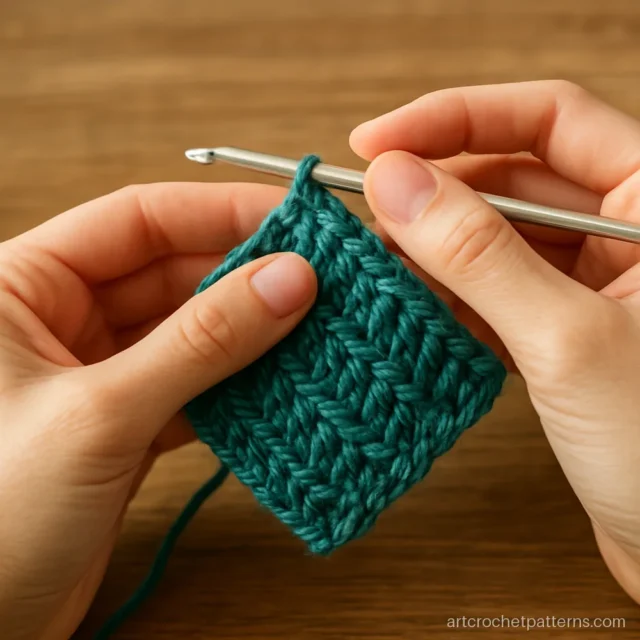 LevelEasyYarnAcrylic worstedHook5 mm (H-8)
Pulling through stitch and loop
The key move: the new loop goes through the stitch and straight through the first loop on the hook.
Maker note: Tilt the hook head down as you pull so it slides through both at once.
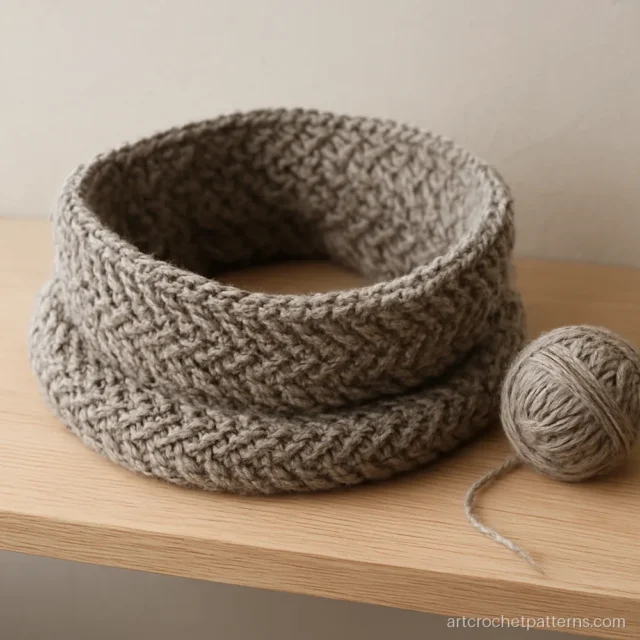 LevelEasyYarnTweed aranHook5.5 mm (I-9)
Spiral cowl in gray tweed
In joined rounds without turning, the slant spirals around the tube, which makes a tidy, modern cowl.
Maker note: Turn every round if you want straight vertical seams; skip turning for the spiral.
How the herringbone crochet stitch differs from plain hdc
| Feature | Half double | Herringbone half double |
|---|---|---|
| Loops after pull up | 3 | 2 |
| Height | Medium | Slightly shorter |
| Look | Straight posts with a third loop bar on the back | Diagonal posts that lean |
| Drape | Firm | Softer, a little stretchy |
| Speed | Fast | Just as fast once learned |
Because the stitch is shorter, a project written for plain half double will come out shorter in length if you swap stitches. Add rows to match the length rather than changing the stitch count.
The herringbone double crochet variation
The herringbone double crochet stitch uses the same trick on a taller stitch. Yarn over, insert the hook, yarn over and drag the new loop through the stitch and on through the nearest wrap (2 loops left). Yo, draw through just 1. Yo, finish through the final pair.
Use ch 3 to turn; most patterns say it does not count. The herringbone double crochet makes a looser, lacier slant that suits shawls and summer wraps. Designers write the steps a little differently, so read the stitch key in any pattern you follow. Compare it with plain double crochet to see how much the twist changes the posts.
Choosing yarn and hook
| Yarn weight | Hook | Result |
|---|---|---|
| DK, weight 3 | 4.5 mm or 5 mm | Fine, close slant for baby blankets and tops |
| Worsted, weight 4 | 5.5 mm, dropping to 5 mm if loose | Clear diagonal lines, good for cowls and hats |
| Bulky, weight 5 | 6.5 mm or 8 mm | Bold texture, quick throws |
Smooth, light colored yarn shows the lean best. Tweeds and soft heathers still look good; dark or fuzzy yarn hides the effect. Plenty of makers size up by a half millimeter, since the stitch packs tighter than plain hdc.
Trouble spots in herringbone rows
| Snag | Reason | What to do |
|---|---|---|
| Hook gets stuck pulling through | The yarn over on the hook is too tight | Keep the first loop loose and point the hook head down |
| Fabric looks like normal hdc | You paused and made 3 loops first | Pull through stitch and loop in one smooth motion |
| Edges creep in | Missed the first or last stitch | Clip a marker into the opening stitch on every pass |
| Swatch slants into a parallelogram | Working in one direction only, in rounds | Turn each row or round, then block |
Where to use it
The herringbone stitch crochet look shines on simple shapes where the texture does the work. Try it on a beanie brim to crown, a throw in one color, or a pillow front. It also pairs well with moss stitch borders for a plain contrast band. For more ideas in the same family, browse the crochet stitches library or the list of stitches for blankets.
Questions makers ask
Is the herringbone half double crochet stitch hard to learn?
No. If you can make a plain half double, you only need to learn one new move, pulling through the stitch and the first loop together. Most people get the rhythm in a few rows.
Does the turning chain count as a stitch?
In most patterns, no. Chain 2, turn, and put the opening herringbone into the very stitch your chain 2 grew from. Always check the notes of the pattern you follow.
Why does my herringbone crochet slant to one side?
That lean is the stitch. Worked in rows, the slant flips each row and forms a zigzag. Worked in rounds without turning, it spirals. Blocking softens any skew at the edges.
What is the difference between herringbone half double and herringbone double crochet?
The herringbone double crochet is taller and needs one extra yarn over and pull through. It makes a more open fabric, while the half double version is dense and warm.
Can I use this stitch for a blanket?
Yes. It drapes well and works up quickly. Plan a little extra yarn since the stitch is dense, and swatch first to set your chain length.
What is the UK name for this stitch?
UK patterns call it the herringbone half treble, because the US half double is a UK half treble.