
Sedge stitch crochet stacks a single crochet, a half double and a double crochet into one stitch, then skips the next two. Row after row, those little three stitch groups tilt against each other and make a dense, grainy fabric that looks like grass bent by the wind, which is where the name comes from.
It is one of the easiest textured stitches to learn because it only uses the three basic stitches and one repeat. It also hides small tension slips well, so it is a kind choice for a first blanket. This guide covers the chain math, a fully counted swatch and the edge problems people run into.
At a glance
Skill level
BeginnerStitches used
sc, hdc, dc, chChain multiple
Threes, then add 2Yarn
Worsted acrylic, wool or cottonHook
5 mm to 6 mmGood for
Blankets, dishcloths, bagsReversible
Yes, both sides look alike
How the crochet sedge stitch is built
Every repeat is one group: (sc, hdc, dc) in the same stitch, followed by skipping two stitches. The group is three stitches wide, and it fills the three stitches it sits over: the one it is worked into and the two skipped ones beside it.
On the next row you turn, and each new group goes into the single crochet at the start of a group below. Since the dc of the old group is now the tall side, the new group leans over it. That push and lean is what makes the grain.
Every move here is one you met in your first week: single crochet, the half double and the double crochet.
Getting the chain count right
The version on this page starts from a chain you can divide by three after taking away two. One chain is the turning chain, which does not count. The rest give you a number of groups times three, plus one single crochet at the far end to anchor the row.
| Chain this many | Groups per row | Stitches per row |
|---|---|---|
| 23 | 7 | 22 |
| 47 | 15 | 46 |
| 101 | 33 | 100 |
| 119 | 39 | 118 |
Other patterns set up the first row a little differently, so their starting chain may be one shorter. Follow the math of the pattern in front of you.
In pictures
What the work should look like, with the yarn and hook used for each sample.
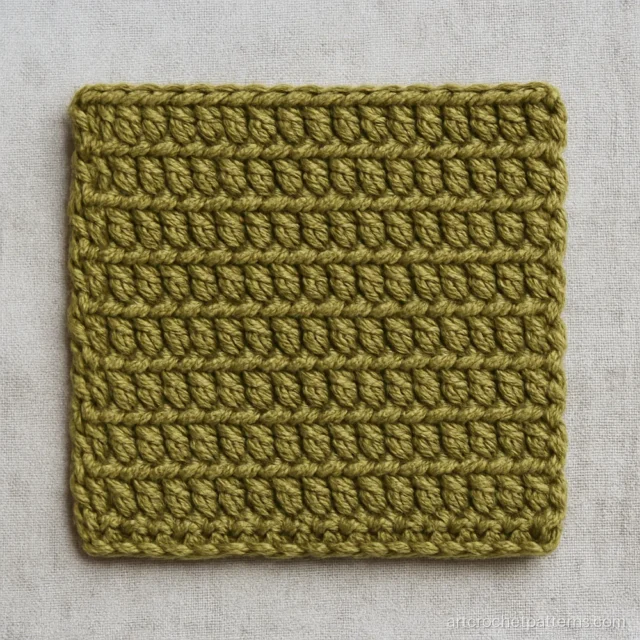 LevelBeginnerYarnWorsted acrylicHook5.5 mm (I-9)
Olive sedge stitch swatch
Each slanted group is one sc, one hdc and one dc in the same stitch. The rows lock together with almost no gaps.
Maker note: Always land the new group in the sc of the group below; that is what keeps the grain lined up.
 LevelBeginnerYarnWorsted wool blendHook6 mm (J-10)
Striped sedge blanket corner
Two row stripes make the sedge grain pop. Leave the resting shade attached and float it along the edge rather than snipping.
Maker note: Switch yarns during the last wrap of the edge sc so every stripe starts crisp.
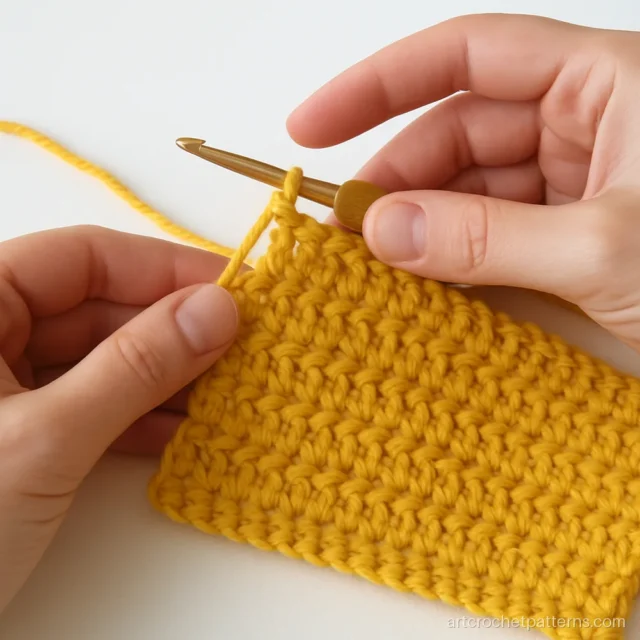 LevelBeginnerYarnWorsted cottonHook5 mm (H-8)
Working a sedge group
The third stitch of the group, the double crochet, goes into the same single crochet as the first two.
Maker note: Pinch the first two stitches of the group with your thumb so you can see the stitch you are still working into.
Counted sedge stitch crochet swatch
- Ch 23.
- Row 1: (Sc, hdc, dc) in 2nd ch from hook, *sk next 2 ch, (sc, hdc, dc) in next ch; rep from * 5 more times, sk next 2 ch, sc in last ch. Turn. (7 groups and 1 sc: 22 sts)
- Row 2: Ch 1 (does not count as a st), (sc, hdc, dc) in first sc, *sk next 2 sts, (sc, hdc, dc) in next sc; rep from * 5 more times, sk next 2 sts, sc in last sc. Turn. (22 sts)
- Rows 3 to 24: Rep Row 2.
- Fasten off and weave in the ends.
Notice that Row 2 begins in the lone sc that ended Row 1, and ends in the sc at the start of the very first group. Every new group should sit in a single crochet; if your hook is heading for an hdc or dc, you have drifted. In worsted yarn on an I-9 hook the swatch measures about 6 inches wide.
Picking yarn and a hook
Sedge is a thick stitch, so it can feel heavy in a stiff yarn. A soft acrylic or a wool blend in worsted weight with a 5.5 mm or 6 mm hook gives a blanket that is warm but still drapes. Cotton works well for dishcloths and market bags, because the solid fabric holds its shape. Avoid very fuzzy yarn, which hides the slant. Self striping yarn looks lovely here, since the short rows show color changes in clean bands.
Wobbly edges and other fixes
| You see | Reason | Try this |
|---|---|---|
| Swatch narrows over rows | The final sc of a row was skipped | End every row with an sc in the sc at the very edge |
| Swatch widens | A group went in the dc instead of the sc | Count groups: there should be 7 in the swatch |
| One edge is ragged, the other smooth | Normal for sedge; the dc side is taller | Finish with a round of sc, working 3 sc in each corner |
| Fabric feels like a board | Tight hands or an undersized hook | Swap to the next hook up |
| Grain looks muddled | Groups worked into skipped stitches | Look for the sc at the base of each group before inserting |
Making a blanket in sedge
For a throw about 50 inches wide in worsted yarn, chain 167 for 55 groups and 166 stitches, then check your own gauge on a swatch first and adjust by threes. Sedge eats a fair amount of yarn because of the three stitch groups, so plan for more than a plain half double blanket of the same size. Planning numbers for other sizes are on the crochet blanket page, and a framed edge from the blanket border ideas finishes it nicely.
Stitches that pair well
Sedge is related to the suzette stitch, whose groups hold just two stitches, a short sc beside a tall dc, with a single skip between. Suzette makes a lighter, smaller grain; sedge is chunkier. You can also alternate bands of sedge with plain rows, or compare it with other blanket stitches before you commit.
Questions makers ask
What exactly is a sedge stitch?
A repeat of one sc, one hdc and one dc all in the same stitch, then skip two stitches. The groups lean on each other and form a thick, slanted texture.
Could sedge stitch crochet be my first blanket stitch?
It is a fine choice. It only uses the three most basic stitches and one repeat, and the busy texture hides small tension changes well.
What multiple do I need for the sedge stitch?
In the version here, chain three for every group plus two more. Some patterns chain one fewer and change the first row, so follow your own pattern's numbers.
Does the sedge stitch curl?
It rarely curls because it is worked back and forth and looks the same on both sides. A light blocking evens out the slight slant at the edges.
How is sedge different from the suzette stitch?
Suzette pairs one short sc with one tall dc and skips a single stitch. Sedge adds an hdc and skips two, so its texture is bigger and the fabric is thicker.