
Fun crochet stitches are the ones that pop, curl, loop or shimmer, and this guide ranks twelve of them by difficulty and teaches the loop stitch from start to finish. Each one is built from moves you already know: yarn overs, pulling up loops, and working several stitches into one spot.
Once you are steady with the basic crochet stitches, these decorative crochet stitches are the quickest way to make a plain scarf or pillow look special. Make a swatch of 15 to 20 stitches for each one before you commit a whole project to it.
At a glance
Skill level
Easy to intermediateYou should know
Chain, sc, hdc and dcSwatch yarn
Smooth worsted in a light colorHook
5 mm (H-8) for worstedTime per swatch
20 to 40 minutesGood for
Pillows, scarves, bags, blanket strips
Twelve fun crochet stitches ranked from easy to tricky
| Stitch | Built from | Difficulty | What it looks like |
|---|---|---|---|
| V stitch | (dc, ch 1, dc) in one st | Easy | Open rows of little Vs |
| Shell stitch | 5 dc in one st | Easy | Fans or scallops |
| Bean stitch | Pulled up loops, closed together | Easy | Small plump ovals |
| Puff stitch | Several tall loops pulled up | Easy | Soft rounded bumps |
| Bobble stitch | 5 unfinished dc closed together | Easy | Firm bumps on one side |
| Loop stitch | sc with a wrapped loop | Easy | Shaggy fringe or fur |
| Popcorn stitch | 5 dc folded into one | Medium | Crisp raised knobs |
| Star stitch | Loops pulled from 5 points | Medium | Dense little stars |
| Waffle stitch | Front post dc grid | Medium | Deep squares like a waffle |
| Alpine stitch | Front post dc over sc rows | Medium | Raised diagonal dots |
| Starburst | Clusters from one center | Medium | Round flower shapes in rows |
| Crocodile stitch | dc worked around posts | Hard | Overlapping scales |
The top half of the list uses nothing beyond the double crochet. The bottom half asks you to work around posts or into several points at once.
How to work the loop stitch
The loop stitch is a single crochet with a long loop locked into it. The loops appear on the side facing away from you, so you work with the wrong side toward you. Start with a row of single crochet as the base.
- Ch 1 and turn so the wrong side faces you. That chain is not counted.
- Wrap the yarn from back to front around your left index finger, which sits behind the work. This wrap becomes the loop.
- Insert the hook into the next stitch. Catch both strands of yarn that run behind your finger and pull them through. You are now holding three loops.
- Hook the yarn and draw it through the whole stack of three. Slide your finger out. A loop now hangs on the far side.
- Repeat in every stitch. Work a row of plain sc on the next row to lock the loops in place.
The far side should show a neat curtain of loops all the same length. Cut them for a shaggy rug texture or leave them whole for a fluffy toy mane.
In pictures
What the work should look like, with the yarn and hook used for each sample.
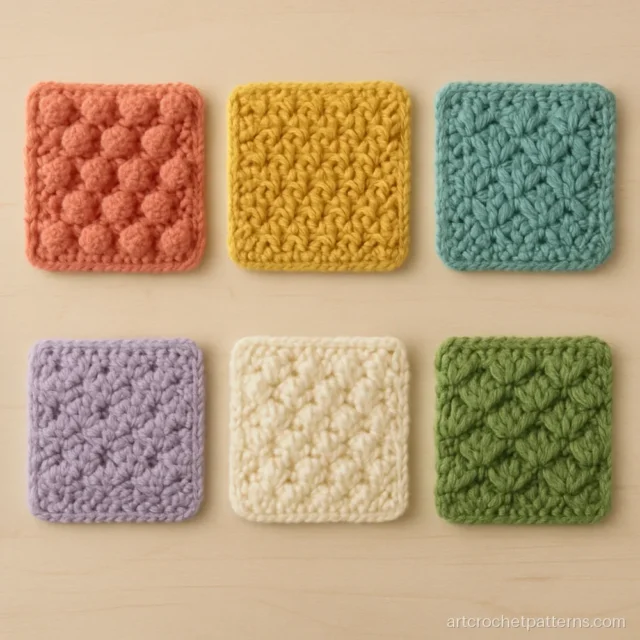 LevelEasy to intermediateYarnWorsted acrylicHook5 mm (H-8)
Sampler of six fancy stitches
Six small swatches side by side so you can compare height and texture. Each is 15 stitches wide in the same worsted yarn.
Maker note: Keep one swatch of every stitch you learn. A labeled sampler beats a notebook when you plan the next project.
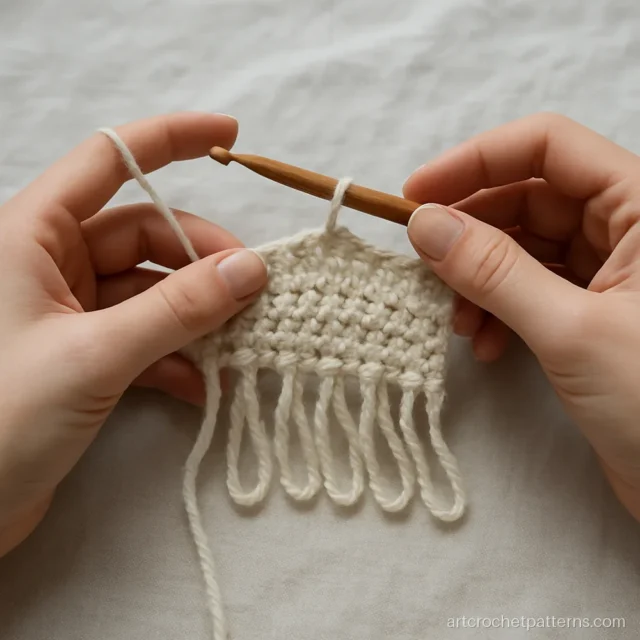 LevelEasyYarnWorsted woolHook5 mm (H-8)
Working the loop stitch
The loop forms behind the work while you face the wrong side. Your finger sets the loop length.
Maker note: Wrap the yarn around one finger every time, never two, so all loops come out the same size.
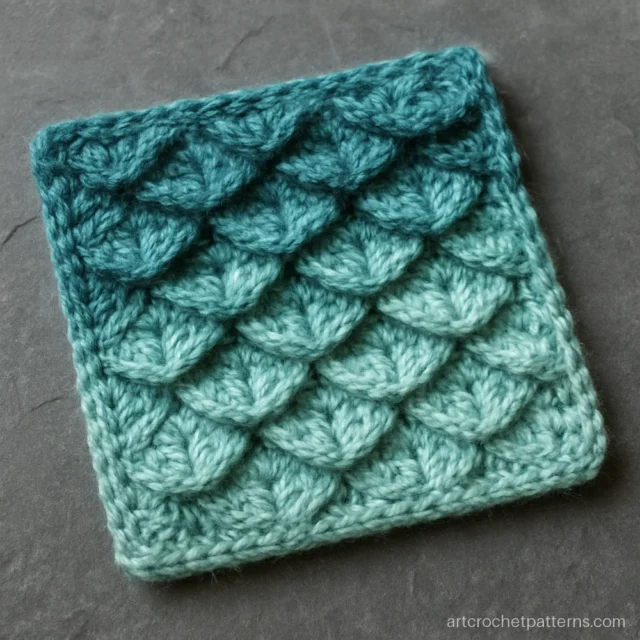 LevelIntermediateYarnDK acrylic gradientHook4.5 mm (7)
Crocodile stitch scales
Rows of overlapping scales made from double crochet worked around posts. A gradient yarn shows off the layers.
Maker note: Work five dc down one post and five up the next; fewer than five makes thin, gappy scales.
Picking yarn for decorative crochet stitches
Texture stitches show best in smooth yarn with good stitch definition. Fluffy yarn blurs bobbles and stars into a fuzzy blob.
| Yarn | Suggested hook | How the texture reads |
|---|---|---|
| Mercerized cotton, worsted | H-8 (5 mm) | Very crisp; bobbles stand out well |
| Acrylic, worsted weight | 5.5 mm (I-9) | Soft and clear, best for practice |
| DK wool | 4 to 4.5 mm | Springy; scales and shells hold their curve |
| Chunky acrylic | 6.5 to 8 mm | Fast, but stars and spikes get bulky |
| Chenille | 6 mm | Hides the stitch shape; avoid for texture |
Pale or bright solid colors show shadows, and shadows are what make texture visible.
Mistakes that flatten a fancy stitch
| Trouble | Reason | Repair |
|---|---|---|
| Bobbles pop out on the wrong side | Bobbles push away from you | Work them on wrong side rows |
| Puffs sink into the fabric | Each loop drawn up only a little | Raise every loop until it stands as tall as a dc |
| Edges get narrower each row | The last stitch is missed after a cluster | Count stitches every row and mark the last one |
| Loops come out uneven | Wrapping a different finger or tension | Use one finger and press it flat against the work |
| Crocodile scales lean | Working the posts in the wrong order | Work down the first post, then up the second |
Projects that suit each stitch
- Pillows and bags: bobble, popcorn and waffle stitch. They are dense and hold a shape.
- Scarves and shawls: V stitch, shell and starburst. They drape and are fast.
- Toys and pet beds: loop stitch for manes, fur and rugs. See the amigurumi section for ideas.
- Blankets: alpine and puff stitch give warmth without much weight. The guide to crochet stitches for blankets compares yardage.
- Wrist warmers and boots: crocodile stitch, worked in the round.
A short practice plan
Learn them in an order that builds skill. Week one: V stitch and shell stitch, since both are only double crochet placed in a new way. Week two: puff and bobble, to learn holding several loops on the hook. Week three: popcorn and star stitch, which add folding and pulling loops from more than one point. Then try waffle and alpine to meet post stitches, and save crocodile stitch for last. For a full library of stitches, step back to the main crochet stitches hub.
Questions makers ask
Which fun stitch should a new crocheter learn first?
The V stitch. It is just (dc, ch 1, dc) worked into one stitch, and the next row goes into the chain spaces. You see a pattern after two rows and it is easy to count.
Are fancy crochet stitches harder on the hands?
Bobbles, popcorns and post stitches use more yarn and more pulling, so they can tire your wrist. Take breaks, loosen your grip and try an ergonomic hook with a soft handle.
Which decorative crochet stitches use the most yarn?
Crocodile stitch, popcorns and bobbles. They can use nearly twice the yarn of plain double crochet over the same area, so buy an extra ball.
Why do my bobbles show on the back instead of the front?
A bobble pushes out on the side facing away from you. So place every bobble on a row where the back of the fabric is toward you, and they bulge out on the front.
Can I mix several fun stitches in one project?
Yes. Sampler blankets do exactly that. Keep the total height similar by matching tall stitches with tall stitches, and check that each strip has the same stitch count.
What is a good fun stitch for a scarf?
Shell stitch or starburst. Both look the same on both sides, drape well and grow quickly in worsted yarn.