
Stacked single crochet is a pair of single crochets built one above the other where a row begins, so together they stand as tall as a double crochet. It replaces the usual chain 3, whose skinny loops so often open a hole beside the first true stitch.
The stacked single crochet stitch is barely slower than chaining, but the edge it leaves is solid and lines up with the rest of the row. Blanket and garment makers use it to get straight side seams and tidy borders. Below: the steps, the count, and where each row's final dc belongs.
At a glance
Skill level
EasyReplaces
Ch 3 at the start of dc rowsCounts as
One dcYarn
Any; easiest in smooth worstedHook
Same as the patternAlso called
Chainless starting dc, stacked sc
Why the stacked single crochet beats a ch 3
Three chains are just three thin loops, while a double crochet is a thick post wrapped in yarn. Side by side, the chain looks skinny and leans outward, opening a hole before stitch two. Down a long blanket edge, those holes add up to a lacy, uneven side.
A stacked sc is two solid stitches piled up. It fills the space, holds the edge straight and gives a firm base for a border or seam. It also ends the guessing about which chain you should hit when the following row runs out.
How to work a stacked single crochet stitch
- Turn your work and do not chain.
- Make an ordinary sc into the edge stitch you just turned to. Draw the first loop up a little taller than usual.
- Find the side strand. Look at that sc from the front. On the side that faces the rest of the row, one vertical strand runs from its top to its base. Right handers find it on the left.
- Slide the hook under that lone strand, entering at the front.
- Bring a loop of working yarn out, wrap, and close it off through the pair on your hook. That is the second sc, sitting on top of the first.
- Keep going. The following dc belongs in stitch two; leave stitch one alone. The stack has already used the first stitch.
In pictures
What the work should look like, with the yarn and hook used for each sample.
 LevelEasyYarnWorsted acrylicHook5 mm (H-8)
Rose swatch with stacked sc edges
Both side edges started with a stacked sc instead of ch 3. The columns at the edge look as solid as the stitches next to them.
Maker note: Pull the first sc of the stack a little taller than usual so the pair reaches full dc height.
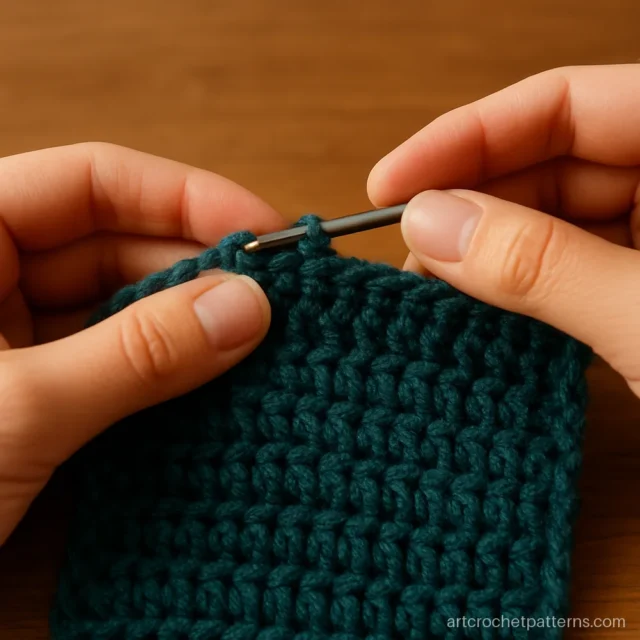 LevelEasyYarnWorsted woolHook5.5 mm (I-9)
Hook in the left leg of the sc
The second sc of the stack goes into the left side strand of the first, not into its top. This keeps the stack upright.
Maker note: Look at the first sc from the front; the strand on the side facing the unworked row is the one to catch.
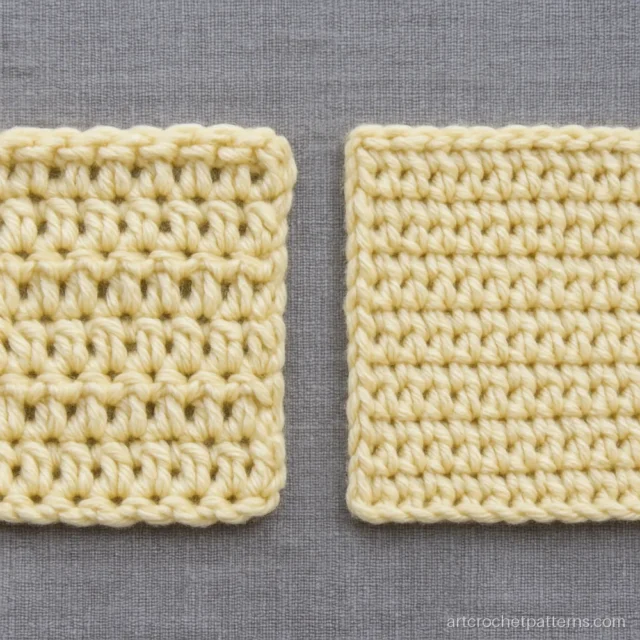 LevelEasyYarnWorsted cottonHook5 mm (H-8)
Ch 3 edge against stacked sc edge
On the left, ch 3 turning chains leave small holes along the edge. On the right, the stacked version is closed and even.
Maker note: Try a pair of test swatches in your chosen yarn; the difference is biggest with cotton.
Practice swatch with stacked sc
This swatch uses a normal chain start, then switches to stacked sc on every row so you can see the difference on one edge.
- Ch 22.
- Row 1: Dc in 4th ch from hook and in each ch across. Turn. (20 sts, counting the skipped ch as a dc)
- Row 2: Stacked sc in first st (counts as dc), dc in each st across, working the last dc in the top of the turning ch. Turn. (20 sts)
- Row 3: Stacked sc in first st (counts as dc), dc in each st across, working the last dc in the top sc of the stack below. Turn. (20 sts)
- Rows 4 to 12: Rep Row 3.
- Fasten off and weave in the ends.
Count each of the opening rows carefully. The classic error is adding a dc beside the stack in that same edge stitch, which adds one stitch per row and makes the swatch flare.
Ending the row in the right place
At the far end of each row you will meet the stack from the row before. Treat its top sc as the last stitch. Look for the V at the top of that upper sc and put the final dc there. If you skip it, the piece will shrink by a stitch on every row; if you work into both the top sc and its side, it will grow.
A locking stitch marker in the top of each stack makes this easy while you learn. Move it up when you start the new stack.
Using it with half doubles and in rounds
For half double crochet rows, a single sc with a slightly taller loop, or one sc plus a stacked slip stitch, often matches better than two sc. Try both and keep the one that looks level with your own stitches.
Worked in rounds, a stack opening every lap also disguises the join. Build the stack right where the previous round closed, work around, then finish by slipping into the upper sc of that stack.
Stacked sc problems
| You notice | The cause | What helps |
|---|---|---|
| Edge shorter than the row | Bottom sc of the pair was made squat | Raise its first loop to about half dc height |
| Stack leans outward | Hook went into the top of the sc, not the side | Use the single vertical strand on the inside edge |
| Row grows by one stitch | Worked a dc into the first stitch too | Start the dc in the second stitch |
| Row loses a stitch | Missed the top of the stack at the row end | Mark the stack and work the last dc into it |
| Edge looks lumpy | Tension changes between the two sc | Keep both sc relaxed and the same size |
When to pick it, and when not
Use stacked sc on blankets with no border, garment pieces that will be seamed, and any dc or tr fabric where the edge shows. A ch 3 is still fine inside lacy patterns, where a small gap blends in, and in patterns whose stitch counts rely on a chain space at the edge. Read your pattern notes before swapping. For other edge tricks, see foundation double crochet for the bottom edge and the crochet borders collection for the finishing round. The wider stitch library has more ideas.
Questions makers ask
What is a stacked single crochet?
It is two single crochets, one worked into the side of the other, used to open a row where a chain 3 would normally go. Together they stand as tall as a double crochet and count as one stitch.
Does the stacked single crochet count toward the total?
It does. In a dc row it counts as the first dc, so your next dc skips ahead to stitch two.
Where does each row's final dc go?
Your closing dc goes into the upper sc of the old stack. That is the stitch the stack replaced.
Can I use stacked single crochet instead of ch 3 in any pattern?
In most solid dc patterns, yes. Check the notes first; a few patterns rely on the chain space at the edge for later rounds or borders.
Is a stacked single crochet the same as a chainless starting dc?
They do the same job in different ways. The chainless starting dc stretches the loop and adds a yarn over, while the stacked sc builds the height from two sc. Both remove the gap of a ch 3.